
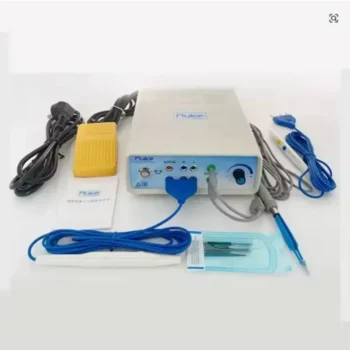

The Electrocoagulation Cautery Pen featured in this product listing is a powered surgical instrument system marketed for cutting, coagulation, hemostasis, eyelid procedures, and minor oral surgery applications. Matching marketplace images show a tabletop control unit supplied with a handheld pen, foot-control pedal, cables, and interchangeable accessories. For U.S. buyers, however, this is not an ordinary beauty tool or home-use skin device. Equipment intended to cut tissue or control bleeding with electrical energy falls into a regulated medical-device category, and the exact model, intended use, electrical characteristics, sterility status, accessories, and FDA marketing authorization should be verified before clinical purchase or use.
Review Current Electrocoagulation Cautery Pen Details
The product title uses several terms that are often mixed together online: electrocoagulation, cautery, cutting, and hemostasis. In professional medical terminology, those words are not always interchangeable. The U.S. Food and Drug Administration distinguishes electrocautery from electrosurgery. Electrocautery heats an instrument electrically and applies that heated instrument to tissue, while electrosurgical equipment passes high-frequency electrical current through tissue to create cutting or coagulation effects. A seller may casually call either system a “cautery pen,” so a clinic should determine exactly which technology the device uses before evaluating it.
This guide is written for U.S. clinicians, medical purchasers, surgical centers, dental or oral-surgery professionals, ophthalmic and plastic-surgery practices, biomedical personnel, and other qualified buyers comparing a compact electrocoagulation or electrosurgical pen system. It focuses on product evaluation, terminology, regulatory checks, electrical safety, accessory verification, surgical-smoke considerations, cleaning and sterility questions, and procurement. It does not provide instructions for performing eyelid surgery, oral surgery, tissue cutting, or hemostasis because those procedures require appropriate professional training, credentialing, patient assessment, and device-specific instructions for use.

Electrocoagulation Cautery Pen Product Overview
The Electrocoagulation Cautery Pen listing describes a powered instrument for eyelid cutting, hemostasis, and minor oral-surgery applications. Matching current retail images show a compact rectangular control unit, a foot pedal, a pen-style handpiece, connection cables, and small electrode or tip accessories. The front panel appears to provide output connections, status indicators, and adjustment controls, but the exact functions should be confirmed from the manual for the specific unit supplied.
This product category is designed around controlled delivery of electrical or thermal energy to tissue. In an appropriately designed electrosurgical system, the energy can produce tissue effects such as cutting or coagulation. Hemostasis refers to controlling bleeding, which is one reason coagulation-capable devices are common in surgical settings. The exact tissue effect depends on device design and settings, but those settings should only be selected by trained users following the manufacturer’s instructions and the clinical requirements of the procedure.
Electrocoagulation Cautery Pen Components Visible in Matching Listings
- Tabletop electronic control unit.
- Pen-style surgical handpiece.
- Foot-control pedal for activation on matching configurations.
- Connection cables and handpiece leads.
- Interchangeable tip or electrode accessories.
- Front-panel ports and status indicators.
- Adjustment controls whose exact purpose should be confirmed in the instructions for use.
- Product documentation or basic manual on some packages.
Electrocoagulation Cautery Pen Specifications Must Be Verified by Exact Model
The marketplace title is widely duplicated across multiple sellers, but dependable model-specific technical data are not consistently published. Buyers should not assume a particular voltage, wattage, frequency, output waveform, number of operating modes, tip material, sterility method, duty cycle, or patient-circuit design unless those details are stated in the exact manufacturer’s documentation. A similar-looking machine can have materially different safety and performance characteristics.
Electrocoagulation Cautery Pen Terminology Matters
The phrase Electrocoagulation Cautery Pen can describe several related technologies in online marketplaces, and correct terminology matters when evaluating equipment for professional use. FDA guidance defines electrocautery as the use of electrical current to heat an instrument that is then applied to tissue; the electrical current remains in the instrument rather than passing through the patient’s tissue. By contrast, an electrosurgical device passes high-frequency current through tissue to create effects such as cutting, coagulation, or ablation.
This distinction affects the type of generator, accessories, patient circuit, electrical safety controls, and regulatory classification that may apply. A clinic comparing devices should therefore ask whether the featured unit is true thermal cautery, monopolar electrosurgery, bipolar electrosurgery, another form of high-frequency surgery, or a multifunction system.
Electrocoagulation Cautery Pen and Electrosurgical Cutting
Electrosurgical cutting uses high-frequency electrical energy to create a controlled tissue effect. FDA-cleared electrosurgical pencils sold in the United States commonly connect to an electrosurgical generator and are indicated for professional cutting and coagulation applications. The featured marketplace product appears to include its own control unit rather than functioning only as a disposable pencil, but that does not establish how its internal generator is designed.
Electrocoagulation Cautery Pen and Hemostasis
Hemostasis is the control of bleeding. Coagulation is one surgical method used to help achieve hemostasis, but the correct technique, power setting, electrode, and clinical indication are procedure-dependent. A product description can legitimately identify hemostasis as an intended function only when that use is supported by the device’s labeling and applicable authorization. Buyers should not infer professional indications from marketing photographs alone.

Electrocoagulation Cautery Pen for Professional Clinical Settings
The Electrocoagulation Cautery Pen is marketed for uses that belong in professional clinical environments. References to eyelid cutting, oral surgery, and hemostasis indicate invasive or potentially invasive applications. These are not suitable do-it-yourself uses, salon procedures, or unsupervised home treatments.
A professional environment provides more than a trained operator. It also provides patient assessment, infection-control systems, emergency readiness, electrical-safety procedures, appropriate anesthesia or analgesia when indicated, documentation, and access to follow-up care. The device itself is only one component of a safe clinical workflow.
Electrocoagulation Cautery Pen for Ophthalmic and Eyelid Procedures
The eyelid is anatomically close to the eye, lacrimal structures, nerves, muscles, and blood vessels. Any powered cutting or coagulation instrument used in this area requires specialty knowledge and careful device selection. A marketplace phrase such as “eyelid cutting” should therefore be viewed as a claimed intended application that needs to be matched against formal labeling, professional scope of practice, and regulatory authorization.
Electrocoagulation Cautery Pen Should Not Be Treated as a Cosmetic Home Device
Consumer plasma pens, mole-removal pens, and beauty devices are often marketed with language that can sound similar to professional surgical equipment. They are not interchangeable. A system intended to cut or coagulate living tissue should not be purchased for self-treatment merely because the handpiece resembles a beauty pen.
Electrocoagulation Cautery Pen for Oral and Minor Surgery
The marketplace title also references oral minor surgery. Oral tissues are highly vascular, and hemostasis can be an important part of dental and oral-surgical procedures. Professional electrosurgical devices are used in some dental environments for soft-tissue management, but the exact instrument must be suitable for the intended procedure and used within the operator’s training and legal scope.
Dental or oral-surgery buyers should verify that the exact machine is labeled for the intended anatomical use, that compatible electrodes are available, and that the electrical output characteristics match the manufacturer-approved applications. They should also verify how the device interacts with other equipment in the operatory.
Electrocoagulation Cautery Pen Requires Appropriate Clinical Credentialing
Ownership of an instrument does not establish competence to use it. Clinicians and facilities should follow state licensing requirements, professional standards, facility policies, manufacturer training requirements, and applicable credentialing rules.
Electrocoagulation Cautery Pen Should Have Clear Instructions for Use
An English-language instructions-for-use document is essential for U.S. clinical buyers. It should identify intended use, contraindications, warnings, electrical ratings, compatible accessories, setup requirements, cleaning and sterilization instructions, maintenance, storage, fault conditions, and service contacts. If the seller cannot provide professional documentation before purchase, that is an important procurement concern.
Electrocoagulation Cautery Pen USA Medical Device Classification
For U.S. buyers, the Electrocoagulation Cautery Pen should be evaluated through the FDA medical-device framework. FDA’s product classification database includes electrosurgical cutting and coagulation devices and accessories under 21 CFR 878.4400, with relevant product categories classified as Class II devices and generally subject to 510(k) premarket review.
That does not mean this specific imported marketplace device has an FDA-cleared 510(k). Classification of a generic device type and clearance of a particular model are separate issues. The seller or manufacturer should be able to identify the exact regulatory status of the exact model being offered.
Electrocoagulation Cautery Pen Buyers Should Request a 510(k) Number When Claimed
If a seller advertises the product as FDA cleared, ask for the 510(k) number, manufacturer legal name, trade name, model, product code, regulation number, and indications for use. Those details can then be compared with FDA’s public database.
A document belonging to another manufacturer, a different generator, or a similar-looking pen does not establish clearance for the featured product.
Electrocoagulation Cautery Pen CE Marking Is Not FDA Clearance
A matching European retail listing displays a CE mark, but European conformity labeling does not replace U.S. FDA requirements. Likewise, establishment registration, ISO certification, FCC paperwork, or a generic test report should not be represented as FDA approval of the exact medical device.
Electrocoagulation Cautery Pen Intended Use Must Match Marketing
FDA explains that medical-device classification depends in part on intended use and indications for use. For an Electrocoagulation Cautery Pen, claims involving eyelid surgery, oral surgery, cutting, and coagulation can influence the regulatory evaluation.
A clinic should therefore review the formal indications rather than relying on broad marketplace keywords. If the manufacturer documents only one type of professional application, buyers should not assume that the same device is automatically authorized for every anatomical area shown in third-party advertisements.
Electrocoagulation Cautery Pen Labeling Should Identify Professional Use
Professional electrosurgical equipment commonly includes detailed warnings and may be prescription-use equipment. The label should identify the intended operator, environments of use, compatible accessories, and limitations. Vague instructions are a significant concern for a device that can intentionally damage or remove tissue.
Electrocoagulation Cautery Pen Marketplace Categories Are Not Regulatory Evidence
Some current marketplace mirrors place this product under beauty, hair-care, makeup, tools, or other unrelated e-commerce categories. Those categories are created for shopping navigation and do not establish whether the product is legally marketed as a medical device in the United States.

Electrocoagulation Cautery Pen Electrical Safety
Electrical safety is central to any Electrocoagulation Cautery Pen. High-frequency surgical devices intentionally deliver energy, and inadequate isolation, grounding, insulation, connectors, or fault protection can create risks to patients and operators.
FDA recognizes IEC 60601-2-2 as a consensus standard addressing basic safety and essential performance for high-frequency surgical equipment and accessories. General medical electrical safety requirements under the IEC 60601 family may also be relevant depending on the device.
Electrocoagulation Cautery Pen Buyers Should Request Electrical Test Documentation
Professional purchasers can ask whether the exact model has been evaluated to recognized medical electrical standards and request the test report or certificate details. The document should identify the manufacturer and model rather than simply showing a generic laboratory logo.
Electrocoagulation Cautery Pen Voltage Must Match U.S. Power
Typical U.S. branch power is approximately 120 V at 60 Hz, but the exact electrical rating of the featured model was not reliably verified from current listing data. Buyers should confirm input voltage, frequency, rated current, power consumption, grounding class, fuse requirements, and plug configuration before purchase. A simple plug adapter does not convert voltage.
Electrocoagulation Cautery Pen Output and Modes
A professional Electrocoagulation Cautery Pen may provide more than one energy mode, but the exact output of this marketplace model should not be guessed from photographs. Some electrosurgical generators provide separate cutting and coagulation waveforms, while other compact devices offer only one specialized output.
The front panel of the matching device shows multiple controls and ports, yet photographs alone cannot establish their electrical function. Clinics should obtain a technical datasheet that lists output power, load range, waveform characteristics, operating frequency, control accuracy, activation method, and protections.
Electrocoagulation Cautery Pen Adjustable Output Requires Trained Use
Adjustable energy can be useful because different approved procedures and electrodes may require different settings. However, it also increases the importance of training and device-specific instructions. The safest setting is not a universal number that can be copied from another machine.
Electrocoagulation Cautery Pen Should Never Be Evaluated Only by Maximum Power
Higher wattage does not automatically mean a better surgical device. Output stability, waveform quality, controls, insulation, electrode compatibility, safety monitoring, service support, and regulatory validation are more important than simply choosing the highest advertised power.
Electrocoagulation Cautery Pen Handpiece and Electrode Accessories
The handheld component is a major part of the Electrocoagulation Cautery Pen system. Matching images show a pen-style applicator with small interchangeable tips or electrodes. A professional buyer should determine whether those accessories are reusable or single-use, sterile or nonsterile, and intended for a particular mode.
Accessory compatibility is a safety issue. Electrode insulation, connector dimensions, materials, and rated voltage need to match the generator. A tip that physically fits may still be electrically unsuitable.
Electrocoagulation Cautery Pen Replacement Tips Should Be Traceable
A clinic should know the accessory part numbers, manufacturer, packaging, sterility status, expiration information when applicable, and reprocessing instructions for reusable components. Replacement availability is also important because a generator can become unusable if proprietary electrodes are no longer sold.
Electrocoagulation Cautery Pen Accessories Should Not Be Improvised
Do not substitute homemade, modified, or unidentified metal tips for manufacturer-approved surgical accessories. Procurement teams should treat accessory compatibility with the same seriousness as the generator itself.

Electrocoagulation Cautery Pen Foot Pedal Control
Matching current product images show a yellow foot pedal supplied with the Electrocoagulation Cautery Pen system. Foot activation is common in professional energy-based surgical equipment because it allows the operator to control activation while keeping the handpiece positioned.
The presence of a pedal does not reveal which energy mode it activates or whether a hand-control option is also available. The exact behavior should be described in the manual.
Electrocoagulation Cautery Pen Foot Switch Should Match the Generator
Activation accessories should be purpose-built and electrically compatible with the generator. Buyers should confirm connector type, cable length, cleaning instructions, environmental rating, and whether the pedal is included in the selected package.
Electrocoagulation Cautery Pen Should Address Accidental Activation
Professional surgical systems are expected to address unintended activation risk through design, labeling, workflow, and training. Buyers should review the manufacturer’s documented safety mechanisms rather than assuming every marketplace unit provides the same protections as an established hospital electrosurgical system.
Electrocoagulation Cautery Pen and Surgical Smoke
When an Electrocoagulation Cautery Pen thermally destroys or vaporizes tissue, smoke or plume can be generated. This is an occupational safety issue for surgeons, dentists, nurses, assistants, and other staff.
OSHA and NIOSH both describe surgical smoke as containing particulate matter and chemical compounds. NIOSH has documented that smoke generated by laser and electrical surgical procedures can contain toxic gases and vapors, bioaerosols, cellular material, and other contaminants. OSHA recommends local smoke evacuation and appropriate work practices.
Electrocoagulation Cautery Pen Purchasers Should Plan for Smoke Evacuation
The featured marketplace system does not appear, from the product title alone, to include integrated smoke evacuation. A facility considering the device should evaluate whether a compatible local smoke-evacuation system is required for its intended procedures and workplace policies.
Electrocoagulation Cautery Pen Surgical Masks Are Not the Whole Strategy
Professional surgical-smoke control relies on source capture and appropriate ventilation rather than simply assuming that an ordinary surgical mask solves plume exposure. Facilities should follow applicable OSHA duties, NIOSH recommendations, state requirements, professional guidance, and their own occupational-safety program.
Electrocoagulation Cautery Pen Cleaning and Sterility Questions
Any Electrocoagulation Cautery Pen used in clinical procedures needs clear infection-control instructions. Some components may be single-use and sterile, while others may be reusable and require validated cleaning, disinfection, or sterilization.
Those distinctions cannot be determined safely from appearance. The handpiece, cable, tip, and pedal may each have different reprocessing requirements.
Electrocoagulation Cautery Pen Buyers Should Ask What Is Sterile
A product package should clearly identify sterile components and the sterilization method where applicable. If tips are supplied nonsterile, the manufacturer should state whether and how they can be sterilized before clinical use. If a component is labeled single use, it should not be treated as reusable merely because it appears physically intact.
Electrocoagulation Cautery Pen Reprocessing Must Be Manufacturer Validated
Facilities should not invent cleaning or sterilization methods for electronic handpieces or electrodes. Excessive heat, liquid immersion, aggressive chemicals, or incompatible sterilization cycles can damage insulation and electrical components. Follow validated instructions for the exact part number.

Electrocoagulation Cautery Pen Near the Eye Requires Extra Caution
The inclusion of “eyelid cutting” in the Electrocoagulation Cautery Pen title deserves particular attention. Surgery near the eye is a specialized area where unintended thermal or electrical injury can have significant consequences.
A buyer should confirm whether the exact device is intended and authorized for ophthalmic, oculoplastic, or periocular use. General authorization for soft-tissue cutting does not automatically establish suitability for every eye-area procedure.
Electrocoagulation Cautery Pen Eye-Area Claims Need Formal Support
Ask the manufacturer for the formal indications for use and contraindications. Verify whether the instructions specifically address ophthalmic precautions, compatible electrodes, and any restrictions involving the eye or surrounding tissues.
Electrocoagulation Cautery Pen Is for Appropriately Trained Professionals
The product should not be promoted as a simple eyelid-beauty tool. Periocular procedures require anatomical knowledge, patient screening, appropriate clinical support, complication management, and professional follow-up.
Electrocoagulation Cautery Pen and Implanted Electronic Devices
Electrosurgical equipment can create electromagnetic energy, which makes implanted electronic devices an important safety consideration. Patients may have pacemakers, implantable cardioverter-defibrillators, neurostimulators, cochlear implants, insulin pumps, or other active devices.
The correct precautions depend on the electrosurgical technology, implant, anatomical site, and procedure. The equipment manual and the implant manufacturer’s guidance should be part of professional planning.
Electrocoagulation Cautery Pen Buyers Should Review Electromagnetic Compatibility
Professional procurement teams should request electromagnetic compatibility information for the exact generator. FDA recognizes medical electrical standards covering EMC and essential performance because electrical medical equipment must function safely in environments containing other electronic systems.
Electrocoagulation Cautery Pen Should Not Be Used Around Implants Based on Guesswork
Patient-specific decisions belong to qualified clinicians following the relevant device instructions and institutional policy. A generic marketplace seller should not be treated as the source of individualized medical advice.
Electrocoagulation Cautery Pen USA Voltage and Plug Verification
Imported Electrocoagulation Cautery Pen systems may be offered in multiple voltage configurations. Because current listings do not reliably identify the exact U.S. electrical version, this must be confirmed before ordering.
U.S. clinics commonly use 120 V, 60 Hz branch circuits for standard equipment, though some facilities also have other dedicated electrical services. The equipment nameplate should identify the input specification.
Electrocoagulation Cautery Pen Plug Adapters Do Not Change Voltage
If a machine is designed only for another voltage, a physical travel plug adapter does not make it electrically compatible. Using medical equipment on an unsuitable supply can damage the device and create safety hazards.
Electrocoagulation Cautery Pen Should Have Appropriate Grounding
Facilities should incorporate new electrical medical equipment into their biomedical or electrical-safety process as required by their policies. Imported equipment without clear grounding, leakage-current, insulation, and safety documentation deserves careful scrutiny.

Electrocoagulation Cautery Pen Warranty and Service Support
Serviceability is often overlooked when purchasing an Electrocoagulation Cautery Pen from an international marketplace. Surgical equipment is only useful while it can be safely maintained and supported.
A low purchase price can become expensive if the generator fails and must be shipped internationally for repair, or if replacement handpieces and electrodes are unavailable.
Electrocoagulation Cautery Pen Buyers Should Ask About Spare Parts
Request part numbers and availability for the handpiece, foot pedal, cables, electrodes, fuses, and other replaceable components. Ask whether service manuals or authorized technicians are available in the United States.
Electrocoagulation Cautery Pen Warranty Terms Should Be Written
Confirm warranty duration, what is covered, who pays shipping, whether repairs are performed or the unit is replaced, expected service arrangements, and what happens if the exact model is discontinued.
Electrocoagulation Cautery Pen Compared with Disposable Cautery Pens
The featured Electrocoagulation Cautery Pen system appears to be a reusable powered generator with external accessories, which differs from simple battery-powered disposable thermal cautery pens.
| Feature | Tabletop Electrocoagulation System | Disposable Thermal Cautery Pen |
|---|---|---|
| Energy System | Generator-based electrical system | Typically heats a fixed cautery tip |
| Control | May provide adjustable output | Usually limited preset operation |
| Accessories | Handpiece, leads, tips, pedal may be included | Self-contained pen |
| Reusability | Generator generally reusable | Often single-use or limited-use |
| Clinical Range | Depends on formal indications and accessories | Depends on pen temperature and labeling |
| Regulatory Review | Must be verified for exact model and intended use | Must also be verified for exact product |
Electrocoagulation Cautery Pen Is a System Purchase
A tabletop generator creates dependencies on compatible cables, tips, handpieces, electrical testing, reprocessing, and maintenance. Buyers should compare total lifecycle cost rather than only the initial price.
Electrocoagulation Cautery Pen Selection Should Follow Clinical Need
The appropriate device depends on the intended professional procedure, regulatory status, facility environment, available accessories, and clinician training. A compact generator is not automatically superior to a disposable cautery pen or a full hospital electrosurgical unit.
Electrocoagulation Cautery Pen Compared with Full Electrosurgical Units
Large hospital electrosurgical units may support multiple monopolar and bipolar modes, advanced monitoring, vessel-sealing features, integrated alarms, and extensive accessory ecosystems. The featured Electrocoagulation Cautery Pen appears more compact and specialized.
A smaller system may be attractive for limited professional applications, but buyers should not assume it offers the same safety monitoring, output range, or accessory compatibility as a full surgical generator.
Electrocoagulation Cautery Pen Compact Size Can Help Workflow
Compact equipment can be easier to place in a small clinic, oral-surgery room, treatment suite, or specialty practice. That benefit is meaningful only if the device’s intended use and safety features match the clinical need.
Electrocoagulation Cautery Pen Should Not Be Chosen by Size Alone
Clinical capability, authorization, electrical performance, reliability, and support are more important than the footprint of the enclosure.

Electrocoagulation Cautery Pen USA Buying Checklist
A U.S. buyer considering this Electrocoagulation Cautery Pen should request a complete technical and regulatory package before purchase. The following questions are more important than marketplace star ratings or promotional claims.
Electrocoagulation Cautery Pen Buyers Should Verify Identity and Manufacturer
Confirm the legal manufacturer name, trade name, exact model number, manufacturing address, U.S. importer or distributor when applicable, and service contact. Matching retail images show branding on the control unit, but a procurement decision should rely on formal documentation rather than the logo visible in a photograph.
Electrocoagulation Cautery Pen Buyers Should Verify FDA Status
Request the 510(k) number if the product is represented as FDA cleared. Check whether the manufacturer and model match the FDA record and whether the indications for use cover the application planned by your facility.
Electrocoagulation Cautery Pen Buyers Should Verify Technical Specifications
Request input voltage and frequency, rated power, output modes, maximum output, operating frequency, accessory ratings, activation method, electrical protection, EMC test information, and applicable IEC 60601 testing.
Electrocoagulation Cautery Pen Buyers Should Verify Sterility and Reprocessing
Determine which accessories arrive sterile, which are single-use, which are reusable, which sterilization methods are validated, and how the handpiece and cables should be cleaned.
Electrocoagulation Cautery Pen Buyers Should Verify Included Accessories
Confirm whether the selected package includes the generator, handpiece, foot pedal, power cord, patient accessories if applicable, cables, electrode tips, manuals, and spare parts. Marketplace photos may show optional accessories that are not included with every variation.
Electrocoagulation Cautery Pen Buyers Should Verify Warranty and Support
Ask about warranty duration, U.S. technical support, repair arrangements, spare-part availability, calibration or preventive-maintenance requirements, and return conditions before purchase.
Electrocoagulation Cautery Pen Professional Advantages and Considerations
Electrocoagulation Cautery Pen Potential Advantages
- Compact generator-style design for professional treatment rooms.
- Pen-style handpiece for controlled professional instrument handling.
- Foot pedal visible in matching product configurations.
- Interchangeable small-tip accessories visible in current product images.
- Marketed for cutting, electrocoagulation, and hemostasis functions.
- Potentially useful for selected professional soft-tissue applications when appropriately authorized and used.
- Smaller footprint than many full-size operating-room electrosurgical generators.
Electrocoagulation Cautery Pen Important Considerations
- Exact technical specifications are not consistently published across marketplace listings.
- FDA clearance of the exact model should not be assumed.
- Electrocautery and electrosurgery describe different technologies.
- Eyelid and oral applications require trained, licensed professionals.
- Surgical smoke requires an occupational-safety plan.
- Accessory sterility and reprocessing must be verified.
- Electrical compatibility with U.S. power must be confirmed.
- Compatible replacement tips and service support should be available.
- Imported medical equipment requires careful regulatory and biomedical review.
Electrocoagulation Cautery Pen Best Fit
The featured product is best evaluated by qualified medical, dental, ophthalmic, plastic-surgery, biomedical, or procurement professionals who can independently verify its regulatory status, intended use, technical performance, safety testing, accessory compatibility, and facility requirements. It is not appropriate as a DIY cosmetic or home surgery instrument.
Electrocoagulation Cautery Pen Frequently Asked Questions
Electrocoagulation Cautery Pen What Is It?
It is a powered professional instrument system marketed for tissue cutting, electrocoagulation, and hemostasis. Matching listings show a tabletop controller, pen-style handpiece, foot switch, cables, and interchangeable accessories.
Electrocoagulation Cautery Pen Is It the Same as Electrocautery?
Not necessarily. FDA distinguishes electrocautery, in which current heats an instrument, from electrosurgery, in which high-frequency current passes through tissue. Buyers should verify the exact technology used by the featured unit.
Electrocoagulation Cautery Pen Can It Cut Tissue?
The marketplace title advertises cutting capability, but the formal intended use and exact operating technology should be confirmed from manufacturer labeling and applicable regulatory documentation.
Electrocoagulation Cautery Pen Can It Control Bleeding?
The product is marketed as a hemostasis and electrocoagulation instrument. Clinical suitability must be determined by qualified professionals using the device within its authorized indications and instructions.
Electrocoagulation Cautery Pen Is It for Eyelid Surgery?
The title specifically references eyelid cutting. Because this is a specialized periocular application, U.S. buyers should verify that the exact device is formally indicated for the intended ophthalmic or oculoplastic use before purchase.
Electrocoagulation Cautery Pen Can It Be Used for Oral Surgery?
The marketplace title also references minor oral surgery. Dental and oral-surgery professionals should verify the exact device labeling, accessories, output, and regulatory authorization for their planned application.
Electrocoagulation Cautery Pen Is It Safe for Home Use?
No home-use assumption should be made. This product is marketed for procedures involving tissue cutting and hemostasis and should be regarded as professional equipment requiring appropriate training and clinical safeguards.
Electrocoagulation Cautery Pen Is It FDA Approved?
The generic category of electrosurgical cutting and coagulation devices includes Class II devices subject to FDA controls, but that does not prove the exact marketplace model is cleared. Ask for and independently verify the model-specific FDA record.
Electrocoagulation Cautery Pen Is It Class II?
FDA classifies relevant electrosurgical cutting and coagulation device categories under Class II regulations. The exact product code and pathway for this device depend on its technology and intended use.
Electrocoagulation Cautery Pen Does It Have a Foot Pedal?
Matching current product images show a foot-control pedal. Confirm that it is included with the selected package and verify which function it activates.
Electrocoagulation Cautery Pen Includes Replacement Tips?
Matching images show small interchangeable accessories, but the number, type, sterility status, and inclusion of each tip should be confirmed with the seller.
Electrocoagulation Cautery Pen What Voltage Does It Use?
A reliable model-specific voltage was not independently verified from current marketplace data. U.S. purchasers should confirm 120 V/60 Hz compatibility or the exact supported input range before ordering.
Electrocoagulation Cautery Pen Creates Surgical Smoke?
Energy-based cutting or coagulation can create surgical smoke when tissue is thermally affected. OSHA and NIOSH recommend appropriate controls, including effective local smoke evacuation.
Electrocoagulation Cautery Pen Needs Smoke Evacuation?
Facilities should evaluate source-capture smoke evacuation for procedures that generate plume and follow OSHA, NIOSH, state, professional, and institutional requirements.
Electrocoagulation Cautery Pen Tips Are Sterile?
Do not assume they are sterile from photographs. Confirm packaging, sterilization method, expiration information, and single-use or reusable labeling for the exact accessories.
Electrocoagulation Cautery Pen Can Tips Be Reused?
Only if the manufacturer identifies them as reusable and provides validated reprocessing instructions. Single-use components should not be reused simply because they appear undamaged.
Electrocoagulation Cautery Pen Is the CE Mark Enough for USA Use?
No. European CE marking does not substitute for applicable U.S. FDA requirements or state and facility requirements.
Electrocoagulation Cautery Pen Works with Pacemaker Patients?
Electrosurgical energy can create electromagnetic-interference considerations for implanted devices. Patient-specific use requires professional evaluation and adherence to the electrosurgical device, implant manufacturer, and facility guidance.
Electrocoagulation Cautery Pen Is Suitable for Beauty Salons?
A product marketed for tissue cutting, coagulation, eyelid procedures, or oral surgery should not be treated as an ordinary salon appliance. Applicable professional licensing, medical-device, and scope-of-practice rules must be respected.
Electrocoagulation Cautery Pen Needs Biomedical Inspection?
Clinical facilities commonly have policies for evaluating electrical medical equipment before service. Imported devices should be reviewed according to the facility’s biomedical, electrical-safety, infection-control, and procurement requirements.
Electrocoagulation Cautery Pen Is Worth Buying?
It may be worth evaluating for an appropriately licensed professional facility only if the manufacturer can provide credible model-specific regulatory documentation, electrical and EMC testing, complete instructions, compatible sterile or reprocessable accessories, warranty support, and technical specifications that match the intended clinical application.

Electrocoagulation Cautery Pen Product Video
The product video below can help buyers review the physical design and included components. A demonstration video should be treated as a visual reference only; it does not replace the manufacturer’s instructions for use, professional training, regulatory documentation, or facility safety procedures.
Electrocoagulation Cautery Pen Final Buying Verdict
The Electrocoagulation Cautery Pen Eyelid Cutting Haemostat is best understood as a professional energy-based surgical instrument system rather than a consumer beauty device. Matching current retail images show a compact control unit, pen-style handpiece, foot pedal, cables, and interchangeable accessories, while the marketplace title positions the equipment for electrocoagulation, cutting, hemostasis, eyelid procedures, and minor oral surgery.
Those applications make regulatory verification essential. FDA classifies relevant electrosurgical cutting and coagulation devices and accessories as Class II medical devices under applicable product categories, and many require 510(k) clearance before legal U.S. marketing. A generic classification does not prove that this particular imported machine has been cleared. U.S. buyers should request the exact regulatory record and compare the manufacturer, trade name, model, and indications with FDA’s database.
Terminology is another major issue. “Cautery” is often used casually online, but FDA differentiates true electrocautery from electrosurgery. A buyer needs to know whether electrical current is heating a tip, passing through tissue, or being delivered through another mechanism because the safety system and compatible accessories depend on the technology.
The product’s eyelid claims deserve additional scrutiny. Procedures around the eye can involve structures where unintended thermal or electrical injury can have serious consequences. Formal labeling should specifically support the intended use, and the device should only be operated by appropriately trained professionals within their legal scope.
Oral-surgery marketing should be evaluated in the same way. A dental or oral-surgery clinic needs to know that the exact generator and electrodes are suitable for its intended soft-tissue work and that the device has appropriate documentation, electrical safety, infection-control instructions, and regulatory status.
Electrical safety is not an optional detail. High-frequency surgical systems are subject to specialized safety considerations, and FDA recognizes IEC 60601-2-2 for high-frequency surgical equipment and accessories. Buyers should request documentation for the exact unit rather than accepting a generic certificate from a supplier.
U.S. voltage compatibility should also be verified before purchase. The current marketplace mirrors do not provide dependable enough data to state a specific input voltage for this model. Request the nameplate rating and confirm that the unit is appropriate for the facility’s electrical supply. A travel plug adapter cannot correct an incompatible voltage.
The accessory ecosystem may determine whether the product remains useful over time. The handpiece, cable, foot pedal, and tips need reliable replacement sources. Clinics should know whether the tips are sterile single-use items, reusable electrodes, or a mixture of both and should obtain validated reprocessing instructions where applicable.
Surgical smoke is another important operational consideration. OSHA and NIOSH recognize hazards from smoke generated by electrosurgical and laser procedures and recommend local smoke control. A compact generator that does not have built-in smoke evacuation may therefore need to be paired with an appropriate facility smoke-management system.
Buyers should also review warranty and service support. Imported medical equipment may be inexpensive to acquire but costly to maintain if repairs require overseas shipping or proprietary replacement parts become unavailable. Written warranty terms and spare-part availability are valuable parts of the purchase decision.
For U.S. searchers comparing an electrocoagulation cautery pen, electrosurgical coagulation device, hemostasis cautery pen, professional electrosurgical instrument, eyelid surgery cautery equipment, oral surgery electrocoagulation device, or compact surgical cautery machine, the featured unit may be relevant to research. It should not be selected solely because the marketplace description lists many clinical uses.
The strongest purchasing process is documentation-first. Confirm the exact manufacturer and model, formal intended use, FDA status, electrical ratings, electrosurgical technology, output specifications, accessory compatibility, sterilization or reprocessing requirements, smoke-management needs, warranty, and U.S. technical support before introducing the equipment into a clinical setting.
If those requirements are met and the product is appropriate for the facility’s licensed clinical services, a compact electrocoagulation system can be evaluated as part of a professional surgical workflow. If the seller cannot provide model-specific documentation or the U.S. regulatory status remains unclear, the safer procurement choice is to compare the product with a clearly documented electrosurgical system from a manufacturer with established U.S. medical-device support.
Electrocoagulation Cautery Pen Review Current Product Details
Use the product page to review the current package and seller information, then independently verify the exact U.S. regulatory status, technical specifications, electrical rating, accessory sterility, and professional-use documentation before purchase.