
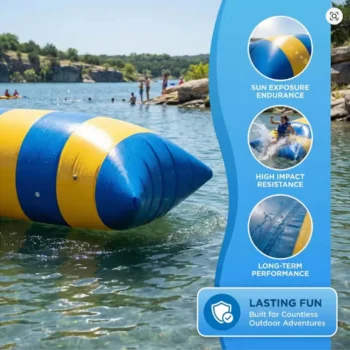

The Commercial Inflatable Water Jumping Blob is a large PVC water attraction designed to create a catapult-style launch experience on lakes and other suitable open-water recreation areas. The current product listing identifies an Ejia IOT-001 water jumping pillow measuring approximately 5 meters by 2 meters, or about 16.5 feet by 6.6 feet, with commercial-oriented PVC construction, an included air pump and carry bag, and white-blue, yellow, or customizable color options.
View Commercial Inflatable Water Jumping Blob
Water blobs are popular because their operating concept is simple but dramatic. One participant is positioned near one end of the inflated pillow while another participant lands on the opposite section, transferring energy through the air-filled structure and launching the first participant into the water. The experience can create an exciting attraction for summer camps, lake resorts, organized waterfront programs, commercial water parks, adventure facilities, and other supervised aquatic recreation businesses.
That excitement also means safety planning is essential. A water jumping blob is not simply a floating lounge or ordinary inflatable toy. Improper inflation, inadequate anchoring, shallow landing water, large participant weight differences, uncontrolled jumps, head-first landings, poor supervision, nearby boats, or a badly designed launch platform can create risks of drowning, collision, head injury, spinal injury, and other serious harm.
For U.S. operators, the attraction should therefore be evaluated as supervised aquatic recreation equipment. A commercial buyer needs to think about the inflatable itself, appropriate personal flotation devices, trained supervisors or lifeguards, emergency procedures, water depth, a controlled landing zone, participant screening, platform design, anchoring, inspections, weather, local regulations, and insurance.
This guide explains the verified product specifications, PVC construction, 5×2-meter dimensions, commercial applications, inflation, anchoring, water-depth planning, launch-zone management, participant supervision, maintenance, storage, customization, shipping, and the most important questions a U.S. buyer should ask before using a water jumping blob at a camp, resort, lake house, rental operation, or commercial attraction.

Commercial Inflatable Water Jumping Blob Product Overview
The Commercial Inflatable Water Jumping Blob currently listed is identified as brand Ejia, model IOT-001. Its advertised dimensions are 5 meters long by 2 meters wide, which converts to approximately 16.5 feet by 6.6 feet.
The product is constructed from premium PVC and is marketed for outdoor water recreation. The current package includes the inflatable blob itself, an air pump for inflation, and a carry bag for transportation and storage. Anchoring equipment, a launch platform, and personal flotation devices are not listed as included in the base package, so commercial buyers should budget for the complete operating environment rather than only the inflatable.
Commercial Inflatable Water Jumping Blob Key Specifications
- Brand: Ejia.
- Model: IOT-001.
- Product type: inflatable water jumping blob / water pillow / launch bag.
- Advertised size: 5 m × 2 m.
- Approximate U.S. dimensions: 16.5 ft × 6.6 ft.
- Material: heavy-duty PVC construction.
- Design: sealed inflatable water recreation pillow.
- Primary environments: lakes, camps, resorts, water parks, and organized waterfront attractions.
- Color shown: white and blue.
- Other advertised color: yellow.
- Custom color options available from the seller.
- Air pump included.
- Carry bag included.
- Product itself does not require continuous electrical operation after inflation.
- Seller identifies CE certification.
- Seller recommends supervised use and lists age 14+ for this configuration.
Commercial Inflatable Water Jumping Blob Accessories Should Be Verified
The current product listing states that a jumping platform, life jackets, and anchor equipment are not included. Those components can be as important as the inflatable itself. Before ordering, ask for a complete packing list and confirm the number and type of D-rings or anchoring points built into the blob.
Commercial Inflatable Water Jumping Blob 5×2 Meter Size
The 5×2-meter format makes this Commercial Inflatable Water Jumping Blob large enough to function as a genuine aquatic launch attraction rather than a small recreational float. At approximately 16.5 feet long and 6.6 feet wide, it requires substantial open water and adequate clearance from docks, shorelines, boats, platforms, rocks, pilings, and other obstacles.
The physical size of the blob is only part of the space requirement. The launched participant travels beyond the end of the inflatable, which means the operator needs a controlled landing area substantially larger than the blob itself.
Commercial Inflatable Water Jumping Blob Requires a Dedicated Waterfront Zone
Do not plan installation by measuring only the inflatable’s footprint. A safe operational layout needs space for the launch structure, blob, anchors, participant staging, water entry and exit, staff supervision, rescue access, and a clear splash-down zone.
Guidance for comparable water blobs calls for substantial open-water clearance around the equipment. The exact manufacturer instructions for the purchased unit should always control, but a commercial operator should expect the attraction to require a dedicated portion of the waterfront rather than sharing a small swimming lane with boats and casual swimmers.
Commercial Inflatable Water Jumping Blob Should Stay Clear of Underwater Hazards
Water can look clear on the surface while hiding rocks, submerged docks, stumps, anchor hardware, shallow shelves, or debris below. The intended landing zone should be assessed before operation and monitored because floating or submerged hazards can change after storms or changes in water level.

Commercial Inflatable Water Jumping Blob PVC Construction
The Commercial Inflatable Water Jumping Blob is advertised as being made from thick, tear-resistant PVC intended for repeated outdoor use. Commercial water-inflatable manufacturers commonly use reinforced PVC tarpaulin because it combines flexibility, waterproofing, strength, and heat-weldable seams.
Comparable commercial water blobs use PVC tarpaulin ranging from roughly 0.8 to 1.0 mm in thickness depending on manufacturer and model. This exact product page describes premium thick PVC but buyers should request the precise material thickness and reinforcement specification for the actual IOT-001 unit rather than assuming a competing product’s measurement applies.
Commercial Inflatable Water Jumping Blob Seams Matter
A water blob experiences repeated deformation every time a participant lands on one end and another participant is launched. That means seam quality is critical. Commercial inflatable manufacturers frequently use high-frequency or hot-air welding instead of relying on simple adhesive construction for primary structural seams.
Ask how the seams on the exact product are manufactured and whether high-stress sections around handles, D-rings, valves, and anchor points receive additional reinforcement.
Commercial Inflatable Water Jumping Blob PVC Still Needs Protection
Heavy-duty material does not make an inflatable indestructible. Sharp rocks, dock hardware, broken glass, fishing hooks, rough concrete, dragging on land, or prolonged exposure to damaging conditions can puncture or abrade PVC. Move and store the blob according to manufacturer instructions.
Commercial Inflatable Water Jumping Blob How the Attraction Works
A Commercial Inflatable Water Jumping Blob stores and transfers energy through its sealed air-filled body. In a properly operated activity, one participant is placed at the designated launch end while another participant lands on the opposite part of the inflatable from an approved platform.
The landing compresses and deforms the blob. That pressure moves through the air-filled structure and causes the participant at the opposite end to rise from the surface and enter the water.
Commercial Inflatable Water Jumping Blob Launch Height Depends on Multiple Factors
The result can vary depending on inflation pressure, participant weight, weight difference between participants, jumping platform height, landing location, inflatable dimensions, and technique.
This variability is precisely why commercial operators should avoid turning the activity into a competition for the highest possible launch. Higher launches can mean harder water impact and greater potential for poor body position.
Commercial Inflatable Water Jumping Blob Should Not Be Used for Tricks
Manufacturer guidance for established water blob products prohibits flips, somersaults, twists, and head-first acrobatics because poor landings can create serious head and spinal injury risks. Participants should follow the instructions of trained staff and the exact operating manual supplied with the attraction.
Commercial Inflatable Water Jumping Blob Safety Planning
Safety planning should begin before a Commercial Inflatable Water Jumping Blob reaches the water. Camps and commercial operators need clear written rules, staff responsibilities, inspection procedures, emergency response plans, participant eligibility rules, weather limits, and equipment requirements.
An inflatable attraction does not become safe simply because it remains afloat. The launch mechanism intentionally sends participants into the air, so the operating environment must control foreseeable hazards.
Commercial Inflatable Water Jumping Blob Requires Competent Supervision
The current seller calls for adult supervision. For organized commercial operation, qualified waterfront supervision should be considered essential. Camp and aquatic safety guidance for blob attractions commonly places trained staff at the launching platform and in positions where they can continuously monitor the landing area.
Commercial Inflatable Water Jumping Blob Should Never Operate Unattended
Access should be prevented when trained staff are not operating the attraction. Leaving a blob floating beside a dock without supervision can invite unauthorized jumping, swimming underneath the inflatable, climbing on equipment, or operation without appropriate flotation devices.

Commercial Inflatable Water Jumping Blob Water Depth
Adequate water depth is a critical requirement for a Commercial Inflatable Water Jumping Blob. The current seller specifies a landing area of approximately 8 to 10 feet deep, or roughly 2.5 to 3 meters.
Comparable U.S. manufacturer guidance also requires at least 8 feet of water in the landing zone. These figures illustrate why the attraction is not appropriate for an ordinary shallow backyard pool, beach edge, or shallow lake cove.
Commercial Inflatable Water Jumping Blob Water Level Can Change
A lake that provides adequate depth early in the season may become shallower during drought or low-water periods. Tides can change coastal depth, and sediment movement can alter underwater contours.
Commercial operators should establish how depth will be checked and document minimum operating limits rather than relying on a measurement made only at installation.
Commercial Inflatable Water Jumping Blob Landing Area Should Be Clear
Depth alone is not enough. The landing area needs to be free of swimmers, kayaks, paddleboards, boats, ropes, anchor lines, underwater structures, rocks, tree branches, and other hazards. Staff should confirm that the area is clear before each authorized launch.
Commercial Inflatable Water Jumping Blob Life Jacket Requirements
Proper personal flotation is a core safety measure for a Commercial Inflatable Water Jumping Blob. Established U.S. Water Blob guidance requires users to wear properly fitted U.S. Coast Guard-approved life vests.
The featured product does not include life jackets, so an American camp, resort, or water attraction should budget for appropriate PFDs in a range of participant sizes.
Commercial Inflatable Water Jumping Blob PFDs Must Fit Correctly
A flotation device that is too large can ride upward during impact, while one that is too small may not secure properly. Staff should check fit and fastening before each participant enters the activity.
Commercial Inflatable Water Jumping Blob PFDs Do Not Replace Lifeguarding
A life jacket is an important layer of protection, but it does not replace supervision, adequate water depth, trained rescue capability, clear landing zones, or controlled participation.
Commercial Inflatable Water Jumping Blob Participant Weight Matching
Participant weight differences affect the launch generated by a Commercial Inflatable Water Jumping Blob. If a much heavier person launches a substantially lighter participant, the resulting height can be much greater and harder to predict.
Established blob operating guidance commonly limits the weight difference between the two participants. One current Water Blob manufacturer advises approximately 30–50 pounds, while BSA guidance uses a maximum differential around 50 pounds. Some camp risk-management programs use even more conservative limits.
Commercial Inflatable Water Jumping Blob Operators Need a Weight Policy
A commercial operator should use the exact manufacturer requirements for the purchased equipment and create a clear procedure for matching participants. Staff should not simply allow any two people to pair themselves together.
Commercial Inflatable Water Jumping Blob Should Not Encourage Extreme Launches
Intentionally pairing a very large jumper with a much smaller participant to maximize height can dramatically increase risk. The attraction should be managed for controlled recreation rather than spectacular launches for social media.

Commercial Inflatable Water Jumping Blob Inflation
The Commercial Inflatable Water Jumping Blob package includes an air pump, making initial inflation more convenient. The correct inflation level is extremely important because both overinflation and underinflation can change how the attraction behaves.
The current seller advises that the pillow should be firm without being excessively hard. Established aquatic guidance similarly warns that inflation affects launch response.
Commercial Inflatable Water Jumping Blob Should Not Be Overinflated
An excessively rigid blob can respond differently to impact and may place more stress on seams and attachment points. Air pressure can also increase as the inflatable warms in direct sunlight.
Commercial Inflatable Water Jumping Blob Should Not Be Underinflated
Too little air can create deep folds or cavities, reduce structural stability, and change how participants move across the surface. Comparable Water Blob manufacturer guidance specifically warns against operation when underinflated.
Operators should monitor condition throughout the day because air temperature, water temperature, sunshine, and repeated use can alter pressure.
Commercial Inflatable Water Jumping Blob Anchoring
Proper anchoring keeps a Commercial Inflatable Water Jumping Blob aligned with the platform and prevents uncontrolled drifting or rotation. The current seller emphasizes anchoring, but anchor hardware is not included in the standard packing list.
Commercial Inflatable Water Jumping Blob Requires Purpose-Planned Anchors
The exact anchor arrangement should follow the manufacturer’s instructions and account for local water conditions. A calm private lake and a coastal resort can experience very different current, tide, wind, and wave loads.
Commercial Inflatable Water Jumping Blob D-Rings Should Be Inspected
Commercial inflatable manufacturers typically reinforce anchor rings and handles because these areas experience concentrated stress. Check rings, straps, welded reinforcement patches, ropes, and anchor lines before each operating session.
Do not use damaged attachment points, and do not improvise by attaching lines to handles that are not designed as structural anchors.
Commercial Inflatable Water Jumping Blob Platform Planning
The launching platform is not included with the featured Commercial Inflatable Water Jumping Blob. Commercial operators therefore need to provide a safe and appropriate structure separately.
This should not be treated as a simple DIY dock addition. BSA aquatic guidance for blob attractions recommends that rigid elevated platforms be professionally designed, approved, and inspected according to applicable codes, with appropriate ladders, guardrails, and known load limits.
Commercial Inflatable Water Jumping Blob Platform Height Matters
Greater platform height can increase the energy transferred into the blob and affect launch height. Follow the blob manufacturer’s approved operating geometry rather than building the tallest platform possible.
Commercial Inflatable Water Jumping Blob Platform Surface Should Be Maintained
Wet platforms can become slippery. Staff should inspect surfaces, stairs, rails, and access points before operation. Damaged lumber, protruding fasteners, sharp edges, splinters, or unstable structural components should be corrected before participants are allowed to use the attraction.

Commercial Inflatable Water Jumping Blob for Summer Camps
Summer camps are one of the most recognizable environments for a Commercial Inflatable Water Jumping Blob. The attraction combines teamwork, anticipation, water recreation, and a dramatic splash-down experience that can become a signature waterfront activity.
Commercial Inflatable Water Jumping Blob Requires Camp Operating Procedures
A camp should create written rules covering staff positions, participant eligibility, swim ability, life jackets, weight matching, jumping technique, landing-zone clearance, emergency response, weather, equipment inspections, and closure procedures.
Commercial Inflatable Water Jumping Blob Staff Training Should Be Documented
Operators should know when to stop the activity, how to identify improper inflation or anchoring, how to respond when a participant does not resurface normally, and how to activate the facility’s emergency action plan.
Commercial Inflatable Water Jumping Blob for Resorts
Lake resorts can use a Commercial Inflatable Water Jumping Blob as a memorable seasonal amenity when appropriate waterfront infrastructure and professional supervision are available.
The attraction can differentiate a resort from properties offering only basic swimming or kayak rentals, but it introduces a higher level of operational responsibility.
Commercial Inflatable Water Jumping Blob Can Become a Scheduled Resort Activity
Rather than leaving the blob accessible throughout the day, resorts can schedule supervised operating sessions. This allows trained staff to inspect the equipment before opening and close access outside operating hours.
Commercial Inflatable Water Jumping Blob Commercial Insurance Should Be Reviewed
Before adding the attraction, discuss the planned activity with the property’s insurance provider or risk manager. Coverage for ordinary swimming or paddlecraft does not necessarily mean an inflatable catapult attraction is automatically covered.
Commercial Inflatable Water Jumping Blob for Water Parks
A Commercial Inflatable Water Jumping Blob can be incorporated into a broader water park or floating aqua park as a dedicated attraction.
Commercial operators need to consider participant throughput, queuing, staff communication, landing-zone exclusion, emergency access, inspection schedules, and equipment replacement cycles.
Commercial Inflatable Water Jumping Blob Can Complement Other Water Attractions
Manufacturers frequently market blobs alongside water trampolines, inflatable obstacle courses, climbing structures, slides, and floating docks. The attraction can add a different type of experience because it uses a launch action rather than simple climbing or sliding.
Commercial Inflatable Water Jumping Blob Should Have Its Own Controlled Zone
A launched participant needs a predictable splash-down area. Do not allow paddleboards, kayaks, swimmers, or traffic from neighboring attractions to cross the launch path.

Commercial Inflatable Water Jumping Blob Age Requirements
The current seller identifies the featured Commercial Inflatable Water Jumping Blob for users age 14 and older with adult supervision. That age recommendation should be incorporated into operating rules unless the manufacturer provides different model-specific written instructions.
Commercial Inflatable Water Jumping Blob Age Is Only One Eligibility Factor
Age does not establish swimming ability, judgment, physical readiness, or ability to follow instructions. Commercial operators should consider all participant criteria stated by the manufacturer, insurer, applicable authority, and facility operating plan.
Commercial Inflatable Water Jumping Blob Should Not Be Used by Unprepared Participants
Participants who cannot follow launch instructions, are uncomfortable with the activity, cannot safely exit the landing area, or do not meet facility eligibility requirements should not be pressured to participate.
Commercial Inflatable Water Jumping Blob Weather Conditions
Weather can change the operating environment of a Commercial Inflatable Water Jumping Blob. Wind can move floating equipment and affect participants in the air, while thunderstorms create obvious hazards for waterfront activities.
Commercial Inflatable Water Jumping Blob Should Not Operate in Rough Conditions
The current seller advises use in calm lakes and protected waters rather than rough water, strong currents, or large waves. Commercial operators should establish specific closure criteria based on the manufacturer instructions and local waterfront conditions.
Commercial Inflatable Water Jumping Blob Air Pressure Changes with Temperature
Hot sunshine can increase internal air pressure, while cooler temperatures can reduce it. Staff should monitor the shape and inflation level rather than assuming the morning setup remains correct all afternoon.
Commercial Inflatable Water Jumping Blob Inspection Routine
A commercial attraction should be inspected before each operating session. The Commercial Inflatable Water Jumping Blob is repeatedly subjected to impacts, flexing, sunlight, water, and anchor loads.
Commercial Inflatable Water Jumping Blob Daily Inspection Points
- Check the PVC body for cuts, tears, abrasion, or punctures.
- Inspect welded seams for separation or unusual deformation.
- Check inflation level.
- Inspect D-rings and reinforced anchor areas.
- Check anchor lines and hardware.
- Confirm platform stability.
- Inspect ladders and guardrails.
- Check the water entry and exit route.
- Confirm the landing area is clear.
- Verify water depth.
- Inspect life jackets and rescue equipment.
- Review current weather and water conditions.
Commercial Inflatable Water Jumping Blob Should Be Removed from Service When Damaged
A commercial operator should not continue running the attraction simply to finish a busy session when a structural problem is discovered. Repairs should follow manufacturer-approved procedures and materials.
Commercial Inflatable Water Jumping Blob Cleaning
The Commercial Inflatable Water Jumping Blob will collect lake water, sunscreen, dirt, mud, algae, and other residues during normal use.
Commercial Inflatable Water Jumping Blob Can Be Cleaned with Mild Products
Comparable manufacturer guidance recommends mild soap, water, or gentle detergent rather than aggressive chemicals that could damage PVC.
Commercial Inflatable Water Jumping Blob Should Dry Before Long-Term Storage
Putting a wet inflatable into a closed storage bag for extended periods can encourage odors, staining, or microbial growth. Follow manufacturer instructions for cleaning, drying, folding, and storage.
Commercial Inflatable Water Jumping Blob Storage
At the end of the season, careful storage can extend the life of a Commercial Inflatable Water Jumping Blob.
Commercial Inflatable Water Jumping Blob Should Be Stored in a Cool Dry Place
The current seller provides a carry bag and recommends dry storage away from prolonged direct sunlight. UV exposure can gradually affect PVC materials, particularly when equipment is left outdoors continuously even when not in use.
Commercial Inflatable Water Jumping Blob Should Not Be Dragged
Dragging a heavy deflated inflatable across concrete, gravel, asphalt, or rough ground can abrade the PVC. Use enough staff and appropriate handling methods when moving the attraction.

Commercial Inflatable Water Jumping Blob Custom Colors and Branding
The featured Commercial Inflatable Water Jumping Blob is shown in a white-and-blue design, while the current listing also advertises yellow and custom color options.
Commercial Inflatable Water Jumping Blob Can Match a Resort or Camp Theme
Commercial facilities may prefer colors that coordinate with existing water-park equipment, camp branding, resort colors, or waterfront signage.
Commercial Inflatable Water Jumping Blob Custom Logo Should Be Confirmed Separately
Many inflatable manufacturers offer logo printing and custom graphics, but the current listing specifically confirms custom colors rather than every possible branding option. Ask the seller whether custom logo printing is available, how it is applied, and whether it changes the production time or price.
Commercial Inflatable Water Jumping Blob CE Certification
The current Commercial Inflatable Water Jumping Blob listing identifies CE certification. That may be relevant to European conformity requirements, but U.S. commercial buyers should not treat a CE mark as automatic evidence that all American state, local, insurance, amusement-device, waterfront, or occupational requirements have been satisfied.
Commercial Inflatable Water Jumping Blob U.S. Requirements Can Vary
Rules governing commercial aquatic attractions can differ between states, counties, cities, camps, resorts, and insurers. Depending on the installation, requirements may address amusement devices, waterfront supervision, lifeguarding, building structures, accessibility, permits, inspection, or insurance.
Commercial Inflatable Water Jumping Blob Buyers Should Contact the Relevant Authority
Before opening a commercial attraction, determine which state or local authority has jurisdiction and what your insurer requires. A manufacturer certificate is only one part of commercial due diligence.
Commercial Inflatable Water Jumping Blob Shipping to the USA
International delivery is an important consideration for a Commercial Inflatable Water Jumping Blob. The blob itself is large when inflated but can be deflated and folded for transport.
Commercial Inflatable Water Jumping Blob Buyers Should Request Packed Dimensions
Ask for shipping weight, package dimensions, shipping method, delivery timeline, customs responsibility, and whether the air pump ships in the same carton.
Commercial Inflatable Water Jumping Blob Buyers Should Confirm Pump Voltage
The inflatable itself does not require electricity while in operation, but the supplied pump does. If ordering for the United States, verify that the included pump is suitable for U.S. electrical supply and comes with an appropriate plug.
Commercial Inflatable Water Jumping Blob Warranty and Repair
A Commercial Inflatable Water Jumping Blob used at a busy waterfront may eventually experience abrasion, punctures, damaged valves, or other wear. Ask what repair support is available before purchasing.
Commercial Inflatable Water Jumping Blob Buyers Should Ask for a Repair Kit
Some competing commercial blob packages include PVC patches, adhesive, or repair materials. The current base listing specifically identifies an air pump and carry bag, so buyers should ask whether a repair kit is also supplied.
Commercial Inflatable Water Jumping Blob Structural Repairs May Need Professional Service
A small surface puncture and a damaged structural seam are not the same problem. Large seam failures, torn anchor reinforcements, or damaged valves may require professional repair rather than a simple field patch.

Commercial Inflatable Water Jumping Blob Compared with Water Trampolines
A water trampoline and a Commercial Inflatable Water Jumping Blob create very different experiences. A trampoline is designed around repeated bouncing on a tensioned jumping surface, while a blob is designed to transfer the impact of one participant into launching another participant into the water.
| Feature | Water Jumping Blob | Water Trampoline |
|---|---|---|
| Main Experience | Launches one participant into water | Bouncing on a floating trampoline |
| Participants | Highly controlled pairs under operating procedures | Depends on manufacturer capacity |
| Platform Needed | Typically requires a suitable launch platform | Usually no separate high launch platform |
| Landing | Participant lands in open water | Participant normally remains on trampoline unless entering water |
| Supervision | Intensive waterfront supervision required | Supervision still required |
| Primary Appeal | Catapult-style thrill | Bouncing and recreation |
Commercial Inflatable Water Jumping Blob Creates a More Dramatic Launch Experience
The launch is what distinguishes a blob from ordinary floating attractions, but it is also why participant controls, water depth, and supervision are so important.
Commercial Inflatable Water Jumping Blob Should Be Chosen for the Operating Environment
A facility that cannot provide trained supervision, deep open water, a safe platform, controlled access, and rescue capability may be better served by a different type of aquatic recreation equipment.
Commercial Inflatable Water Jumping Blob Compared with Floating Water Parks
Floating obstacle courses provide climbing, sliding, balancing, and crawling elements, while a Commercial Inflatable Water Jumping Blob focuses on one high-energy launch activity.
Commercial Inflatable Water Jumping Blob Can Add a Signature Attraction
A water park may use the blob as one dedicated feature within a larger waterfront program. This gives visitors a distinct experience rather than another variation of a slide or climbing element.
Commercial Inflatable Water Jumping Blob May Require More Staff Control
Because each launch depends on participant pairing, platform control, and landing-zone clearance, throughput must be managed carefully rather than allowing uncontrolled free play.
Commercial Inflatable Water Jumping Blob USA Buying Checklist
Before purchasing a Commercial Inflatable Water Jumping Blob for a U.S. facility, request complete written specifications and operational documents.
Commercial Inflatable Water Jumping Blob Buyers Should Confirm Dimensions
The current model is advertised at 5×2 meters, approximately 16.5×6.6 feet. Ask for inflated height and packed dimensions as well.
Commercial Inflatable Water Jumping Blob Buyers Should Confirm PVC Specification
Request material thickness, reinforcement construction, seam method, UV resistance information, and repair recommendations.
Commercial Inflatable Water Jumping Blob Buyers Should Confirm Anchor Points
Ask how many structural anchor points are installed, their rated capacity if available, and the manufacturer’s recommended anchoring pattern.
Commercial Inflatable Water Jumping Blob Buyers Should Confirm Inflation Requirements
Request recommended inflation condition or pressure, pump specifications, approximate inflation time, and how frequently air pressure should be checked.
Commercial Inflatable Water Jumping Blob Buyers Should Confirm Platform Requirements
Ask for approved platform height, lateral positioning, distance between platform and blob, and other installation dimensions.
Commercial Inflatable Water Jumping Blob Buyers Should Confirm User Requirements
Request written minimum age, maximum participant weight, permitted weight difference, swimming requirements, PFD requirements, and number of users.
Commercial Inflatable Water Jumping Blob Buyers Should Confirm Water Requirements
Verify minimum water depth, required open landing distance, current limitations, wave limitations, and obstacle clearance.
Commercial Inflatable Water Jumping Blob Buyers Should Confirm Included Accessories
The current package lists the water blob, pump, and carry bag. Confirm whether repair materials, ropes, anchors, spare valves, or other accessories are included.
Commercial Inflatable Water Jumping Blob Buyers Should Confirm Commercial Warranty
Some inflatable warranties exclude or limit rental or intensive commercial operation. Request written warranty terms specifically covering your proposed business use.
Commercial Inflatable Water Jumping Blob Buyers Should Confirm USA Compliance Needs
Discuss the attraction with your insurer, local authority having jurisdiction, waterfront safety professional, and other relevant officials before installation. Confirm whether inspections, permits, platform approvals, lifeguard coverage, or other requirements apply.
Commercial Inflatable Water Jumping Blob Frequently Asked Questions
Commercial Inflatable Water Jumping Blob What Is It?
It is a sealed inflatable water pillow used to launch one participant into the water when another participant lands on the opposite end under controlled supervision.
Commercial Inflatable Water Jumping Blob What Size Is It?
The featured Ejia IOT-001 model is advertised at approximately 5 meters by 2 meters, or 16.5 feet by 6.6 feet.
Commercial Inflatable Water Jumping Blob What Is It Made From?
The current listing describes thick, tear-resistant premium PVC intended for commercial water-recreation use.
Commercial Inflatable Water Jumping Blob Includes an Air Pump?
Yes. The current packing list identifies an air pump and carry bag.
Commercial Inflatable Water Jumping Blob Includes Anchors?
The current listing states that anchor equipment is not included, so the operator should plan the anchoring system separately according to manufacturer guidance.
Commercial Inflatable Water Jumping Blob Includes Life Jackets?
No. Life jackets are not identified as included with the current base package.
Commercial Inflatable Water Jumping Blob Includes a Jumping Platform?
No. The launching platform is a separate structure.
Commercial Inflatable Water Jumping Blob How Deep Should the Water Be?
The seller specifies approximately 8–10 feet, or around 2.5–3 meters, in the landing zone. Comparable U.S. blob guidance also uses at least 8 feet as a minimum. Follow the exact operating manual for the purchased model.
Commercial Inflatable Water Jumping Blob Can Be Used in a Swimming Pool?
Only if the pool environment meets every manufacturer requirement for depth, clearance, anchoring, platform configuration, supervision, and landing area. Many ordinary residential pools will not provide suitable dimensions or depth.
Commercial Inflatable Water Jumping Blob Can Be Used in the Ocean?
The seller advertises lake and sea use, but also warns against rough water, strong currents, large waves, and high wind. Coastal operation requires careful evaluation of tides, currents, anchoring, weather, and local rules.
Commercial Inflatable Water Jumping Blob Is Suitable for Camps?
Yes. Summer camps are one of the product’s intended environments, provided the camp has suitable water, trained supervision, appropriate PFDs, safe platform infrastructure, and written operating procedures.
Commercial Inflatable Water Jumping Blob Is Suitable for Resorts?
Yes, when a resort can provide a controlled waterfront operating zone, staff supervision, appropriate insurance, inspection procedures, and safe access.
Commercial Inflatable Water Jumping Blob Is Suitable for Water Parks?
Yes. It can function as a commercial water attraction when integrated into a professionally managed aquatic operation.
Commercial Inflatable Water Jumping Blob Can Be Rented?
Potentially, but commercial rental introduces additional concerns involving transportation, setup verification, operator training, insurance, local regulations, and ensuring that every installation site meets water-depth and safety requirements.
Commercial Inflatable Water Jumping Blob What Age Is Recommended?
The current seller lists age 14+ with adult supervision for this model. Follow the exact manufacturer instructions, insurer requirements, and facility policy.
Commercial Inflatable Water Jumping Blob How Many People Use It?
Comparable blob operating guidance generally uses one person waiting to be launched and one person landing on the opposite end, with controlled staff supervision. Follow the exact manufacturer rules for this model.
Commercial Inflatable Water Jumping Blob Can Users Do Flips?
Comparable U.S. Water Blob safety guidance prohibits flips, somersaults, and aerial tricks because head or neck landings can cause severe injury.
Commercial Inflatable Water Jumping Blob Requires Life Jackets?
Established U.S. blob operating guidance requires properly fitted U.S. Coast Guard-approved life vests. Commercial operators should follow the manufacturer’s instructions and applicable facility requirements.
Commercial Inflatable Water Jumping Blob Requires Lifeguards?
A commercial facility should have qualified aquatic supervision appropriate to the attraction, location, applicable rules, insurer requirements, and emergency action plan.
Commercial Inflatable Water Jumping Blob Should Be Anchored?
Yes. Proper anchoring is essential for maintaining alignment and preventing uncontrolled movement.
Commercial Inflatable Water Jumping Blob Can Be Towed Behind a Boat?
No towing use should be assumed. Established Water Blob manufacturer guidance specifically states that comparable blob products are not towable.
Commercial Inflatable Water Jumping Blob Can Be Left in the Water Unsupervised?
It should not remain available for unauthorized use. Commercial operators should control access whenever trained staff are not supervising the attraction.
Commercial Inflatable Water Jumping Blob Should Be Fully Hard When Inflated?
The current seller advises a firm but not rock-hard condition. Inflation should follow model-specific manufacturer instructions.
Commercial Inflatable Water Jumping Blob Can Be Customized?
Yes. The current listing advertises custom colors in addition to white-blue and yellow options.
Commercial Inflatable Water Jumping Blob Is CE Certified?
The current seller identifies CE certification. U.S. operators should still separately verify applicable state, local, insurer, waterfront, and commercial attraction requirements.
Commercial Inflatable Water Jumping Blob Is Worth Buying?
It can be a compelling attraction for a professionally managed camp, resort, lake property, or water park that has deep open water, suitable infrastructure, trained supervisors, appropriate PFDs, insurance, and a disciplined operating program.

Commercial Inflatable Water Jumping Blob Final Buying Verdict
The Commercial Inflatable Water Jumping Blob PVC Pillow offers a distinctive attraction for camps, lake resorts, water parks, adventure businesses, and organized waterfront programs. The featured Ejia IOT-001 combines an approximately 5×2-meter size with commercial-oriented PVC construction, an included air pump and carry bag, and customizable color options.
Its main advantage is the experience it creates. Water slides and floating obstacle courses are common, but a launch blob offers a different combination of teamwork, anticipation, flight, and splash-down. For a properly managed waterfront, it can become one of the activities visitors remember most.
However, this is also an attraction where operating procedures matter as much as product quality. The launch action means the facility must control participant pairing, water depth, body position, platform access, landing-zone clearance, anchoring, weather, and supervision.
The advertised 5×2-meter dimensions are suitable for a substantial recreational blob, but operators need much more space than 16.5×6.6 feet. A clear landing zone and open-water buffer should surround the attraction, with boats, casual swimmers, paddlecraft, docks, and underwater hazards kept away from the active launch path.
Water depth is particularly important. The current seller identifies approximately 8–10 feet in the landing area, and established U.S. Water Blob guidance similarly calls for at least 8 feet. An operator should confirm depth before opening and continue monitoring it when seasonal water levels can change.
Personal flotation should also be part of the operating program. Comparable U.S. manufacturer and camp guidance requires properly fitted approved life jackets. The current product does not include these, so they should be budgeted separately.
Anchoring equipment is another separate cost. The blob needs to remain correctly aligned with the jumping platform instead of drifting or rotating. Ask the manufacturer for a specific anchor diagram and inspect attachment points before every operating session.
The platform itself deserves professional attention. It should not be improvised simply to create a higher launch. Camp safety guidance recommends professionally designed and inspected elevated structures with appropriate access, rails, structural load capacity, and positioning.
Participant weight matching should be incorporated into staff procedures. Established blob guidance limits large weight differences because a much heavier jumper can produce unexpectedly high launches for a smaller participant. The exact limits for the purchased product should come from its manufacturer.
Operators should also prohibit flips and other aerial tricks unless an authoritative manufacturer protocol explicitly permits them. Current guidance for established water blob attractions warns that flips and head-first landings can lead to serious head, neck, or spinal injuries.
The included air pump adds convenience, but U.S. buyers should confirm its voltage and plug. The blob itself is a sealed air bag and does not need continuous electrical power during use, but inflation equipment must still be electrically compatible with the location.
PVC quality and welding are important to long-term value. Ask the seller for the exact material thickness, reinforcement construction, welding process, and repair instructions. Pay particular attention to anchor areas because those points experience significant stress.
Commercial operators should also request written warranty terms. A warranty suitable for occasional private use may not provide equivalent protection for a rental company or water park operating the attraction every day during summer.
For U.S. shoppers searching for a commercial inflatable water jumping blob, water blob launcher, inflatable water pillow, lake jumping blob, water catapult inflatable, commercial water park blob, summer camp water blob, or PVC water jumping pillow, this product is a relevant option to compare.
The ideal buyer is not simply someone with access to a lake. It is a camp, resort, commercial operator, or experienced waterfront owner that can provide suitable deep water, a safe platform, controlled access, professional supervision, appropriate PFDs, anchoring, rescue capability, inspections, and insurance.
Before ordering, verify the 5×2-meter dimensions, PVC thickness, reinforced anchor design, approved participant weights, age guidance, maximum weight differential, water-depth requirements, launch-platform specifications, inflation instructions, pump voltage, complete accessory list, repair kit, custom color requirements, commercial warranty, packing dimensions, freight arrangements, and any certification documentation.
When those operational requirements are properly addressed, a Commercial Inflatable Water Jumping Blob can provide a memorable aquatic attraction. Its value comes not only from the excitement of the launch but from combining that experience with disciplined waterfront management and a safety-first operating program.
Commercial Inflatable Water Jumping Blob Shop and Compare
Review the current product details and request the full operating manual before commercial use. Confirm water-depth requirements, participant rules, PVC specifications, anchoring, platform requirements, pump voltage, included accessories, and warranty before ordering.