
Factory Micro Drum Filter for Koi Pond Complete Guide
Keeping a koi pond clear is not simply about making the water look attractive. A well-designed filtration system must continuously remove fish waste, uneaten food, leaves, algae fragments, and other suspended solids before they break down and place additional demand on the pond’s biological filtration. For serious koi keepers, an automatic micro drum filter for koi pond can dramatically change how mechanical filtration is managed.
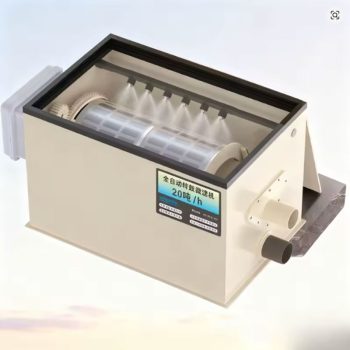
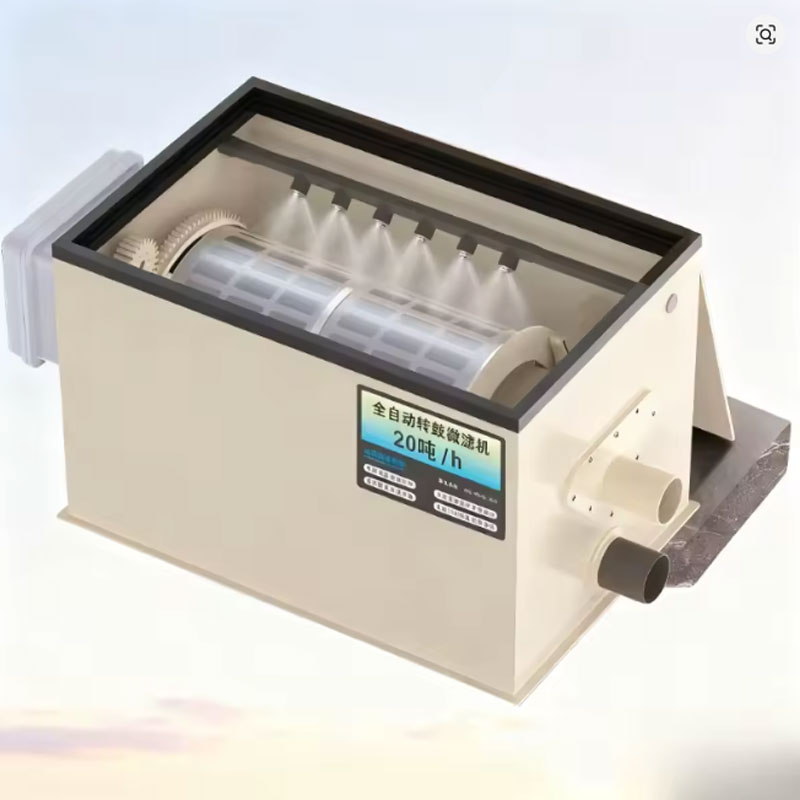
The Factory Micro Drum Filter for Koi Pond is designed around rotary-drum mechanical filtration. Instead of relying on filter pads that need to be removed and washed by hand, the drum screen separates suspended particles from circulating pond water and can use an automatic backwash cycle to clean the screen and send collected debris toward a waste outlet.
For U.S. pond owners searching for a koi pond drum filter, rotary drum filter for koi pond, automatic koi pond filter, self-cleaning pond filter, RDF koi pond filter, micro screen pond filter, mechanical koi pond filtration system, automatic backwash pond filter, or aquaculture drum filter, this type of equipment can provide a more automated alternative to traditional brushes, foam pads, settlement chambers, and manually cleaned mechanical media.
Rotary drum filters are particularly attractive for heavily stocked koi ponds because koi continuously generate solid waste. Food that is not eaten also contributes to the solids load, while outdoor ponds collect leaves, pollen, insects, string algae fragments, and windblown debris. Removing these materials promptly can help the rest of the filtration system work more efficiently.
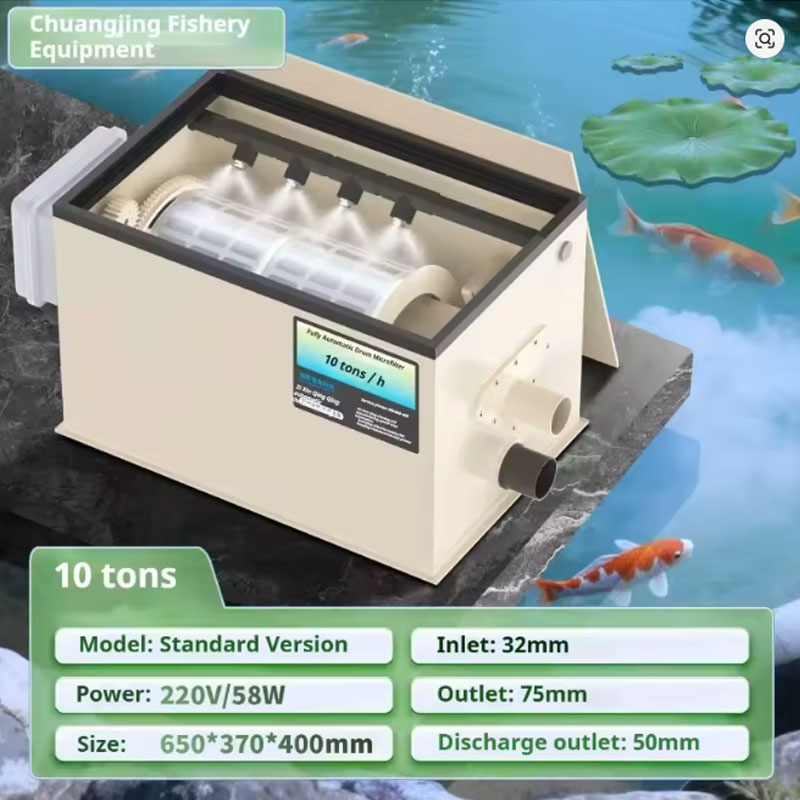
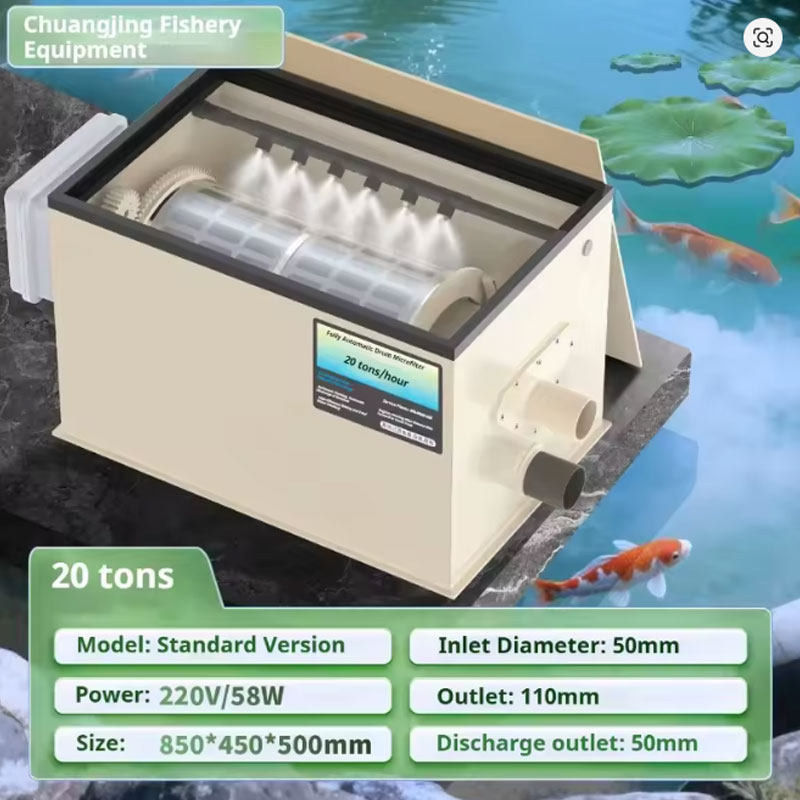
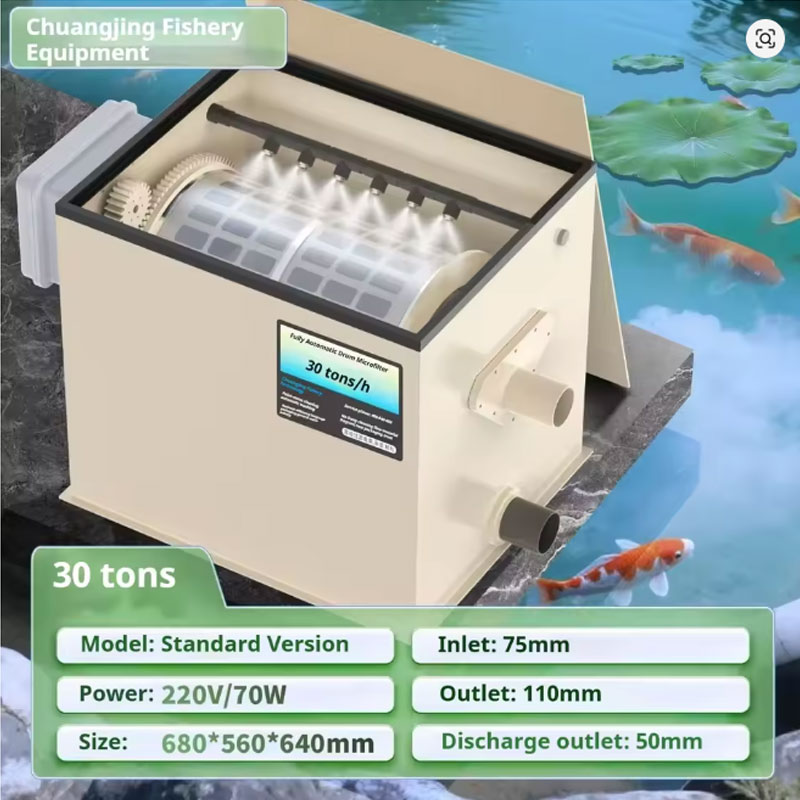
The exact flow rate, screen-mesh rating, voltage, housing material, inlet size, outlet configuration, backwash pump, control system, and installation method can vary between factory drum-filter configurations. Because those details determine whether a unit is appropriate for a specific U.S. pond, they should always be confirmed for the exact selected model rather than copied from another visually similar rotary drum filter.
This comprehensive guide explains what a micro drum filter is, how automatic backwashing works, how to select flow capacity, how micron ratings affect filtration, gravity-fed versus pump-fed installation, bottom-drain integration, biological filtration, plumbing, maintenance, troubleshooting, winter operation, electrical considerations, and the most important questions to ask before purchasing a koi pond RDF.
What Is a Micro Drum Filter for a Koi Pond?
A micro drum filter is a mechanical water-filtration device built around a rotating cylindrical screen. Pond water flows through the fine screen while suspended solid particles larger than the screen openings remain trapped on the dirty side of the drum.
As debris accumulates, water becomes more difficult to pass through the screen. An automatic cleaning system then rotates the drum while spray nozzles wash debris away from the mesh and into a separate waste channel.
Mechanical Filtration Happens Before Biological Treatment
The primary job of an RDF is to physically remove suspended solids. It should not automatically be treated as a complete biological filtration system unless the selected product specifically incorporates a separate biological-media chamber.
In a high-quality koi pond system, mechanical filtration and biological filtration typically perform different jobs.
The Drum Removes Waste Before It Decomposes
Instead of allowing fish waste, food particles, and organic debris to remain trapped inside foam or brushes for long periods, a self-cleaning drum filter can separate that material and flush it toward the waste line.
How a Rotary Drum Filter Works
The operating principle is relatively straightforward even though the equipment may contain an electric drive motor, water-level sensor, control box, spray bar, valves, and backwash pump.
Step One: Pond Water Enters the Filter
Water from the pond enters the drum-filter chamber. In a gravity-fed installation, water may arrive from bottom drains and skimmers. In a pump-fed installation, a pump pushes water toward the filter.
Step Two: Water Passes Through the Screen
The screen allows water to pass while retaining suspended particles larger than the screen openings.
Step Three: Solids Accumulate on the Dirty Side
Fish waste, leaves, food fragments, algae particles, and other debris gradually cover the screen.
Step Four: Water Level Changes
As the screen becomes restricted, the difference between the dirty and clean sides of the filter can increase. Automatic systems can use a water-level sensor to detect this condition.
Step Five: The Drum Rotates
The motor turns the cylindrical screen so the dirty section passes beneath the cleaning spray bar.
Step Six: Backwash Nozzles Clean the Screen
Pressurized water sprays through the screen, dislodging trapped waste.
Step Seven: Waste Leaves Through a Separate Drain
The removed solids are directed into a waste trough or sewage outlet rather than being returned to the koi pond.
Why Automatic Backwashing Is Valuable
Traditional mechanical filters require the pond owner to physically remove or clean filter media. This can become time-consuming in a heavily stocked pond.
The Filter Cleans While the Pond Continues Operating
A properly designed automatic RDF can initiate its cleaning cycle when necessary without requiring the owner to disassemble the filtration system.
Waste Is Removed From the Water Circuit
Debris is not simply moved from one filter chamber to another. The backwash system directs concentrated solids toward a dedicated drain.
Automation Does Not Mean Zero Maintenance
Spray nozzles can become blocked, screens can require periodic inspection, sensors need to remain clean, and motors, pumps, seals, and waste lines still require routine attention.
Why Koi Ponds Produce a Heavy Solids Load
Koi are large, active fish that are commonly fed substantial amounts during warm growing seasons.
Fish Waste Enters the Pond Every Day
The more koi a pond contains and the more heavily they are fed, the more solid waste the filtration system must manage.
Uneaten Food Adds Organic Material
High-quality feeding practices reduce waste, but small particles and occasional uneaten pellets still reach the filtration system.
Outdoor Debris Adds Another Load
Leaves, pollen, flower petals, soil, insects, and windblown material can all enter an outdoor pond.
Algae Can Produce Significant Mechanical Waste
String algae and floating algae fragments can break loose and travel toward the drains and filtration system.
Why Removing Solids Quickly Matters
Organic material does not remain unchanged after entering the pond.
Waste Begins Breaking Down
As solids decompose, they add to the overall biological load of the system.
Fine Debris Can Reduce Water Clarity
Suspended particles can make water look cloudy even when ammonia and nitrite levels are otherwise controlled.
Mechanical Filtration Supports the Biological Stage
Removing larger solids before water reaches biological media allows that media to focus more effectively on dissolved nitrogen compounds rather than becoming overloaded with physical debris.
Micro Drum Filter vs Filter Brushes
Filter brushes have been used successfully in koi ponds for many years, but they require a very different maintenance routine.
Brushes Trap Waste Within the Filter Chamber
Debris becomes physically entangled between the brush fibers and remains there until the owner cleans the chamber.
Drum Filters Separate and Discharge Waste
An automatic drum filter is designed to move trapped solids toward a separate waste outlet during the cleaning cycle.
Brushes Can Still Work in Simpler Systems
Not every koi pond requires an automatic RDF. Smaller ponds with light fish loads may operate effectively with conventional mechanical filtration when the owner is comfortable performing regular manual cleaning.
Micro Drum Filter vs Foam and Filter Pads
| Feature | Micro Drum Filter | Foam / Filter Pads |
|---|---|---|
| Cleaning | Automatic or semi-automatic backwash | Usually manual |
| Waste Removal | Directed toward waste outlet | Waste stays in media until cleaning |
| Labor | Lower routine manual cleaning | Can require frequent washing |
| Fine Mechanical Filtration | Controlled by screen rating | Controlled by media density |
| Operating Complexity | Higher | Lower |
| Electrical Components | Usually present | Often unnecessary |
| Initial Cost | Generally higher | Generally lower |
Automation Is the Main Advantage
The largest practical difference is not simply water clarity. It is how waste is handled after being captured.
Automatic Systems Trade Simplicity for Convenience
An RDF has more components than a basic filter pad. The tradeoff is substantially less frequent manual media washing when the system is sized and installed correctly.
Micro Drum Filter vs Bead Filter
Bead filters and drum filters are both common in koi pond discussions, but they operate differently.
A Drum Filter Uses a Screen
Physical solids are captured at the rotating mesh and backwashed toward waste.
A Bead Filter Uses Packed Media
Water moves through a vessel containing beads or similar media that trap particles and may also provide some biological surface area.
Some Ponds Use More Than One Filtration Technology
A large koi pond may combine an RDF with moving-bed biofiltration, showers, bead filtration, UV clarification, or other components depending on the system design.
Mechanical Filtration vs Biological Filtration
This distinction is essential for new koi keepers.
Mechanical Filtration Removes Physical Particles
Fish waste, food, leaves, and suspended debris are mechanical-filtration targets.
Biological Filtration Handles Dissolved Nitrogen Waste
Beneficial bacteria convert toxic ammonia and nitrite through the nitrogen cycle.
A Clear Pond Is Not Automatically a Biologically Safe Pond
Water can look visually clean while containing dangerous dissolved ammonia or nitrite. Water testing and adequate biological filtration remain necessary even when an RDF produces excellent mechanical clarity.
Why an RDF Works Well Before a Moving Bed Biofilter
Moving-bed filters use floating biological media that continuously moves through aerated water.
Cleaner Water Reaches the Biological Media
When an RDF removes suspended solids first, less debris accumulates in the biological chamber.
Bio Media Can Focus on Nitrification
The biological stage can concentrate on converting ammonia and nitrite rather than acting as the primary solids trap.
This Creates a Logical Multi-Stage System
Bottom drain or skimmer → mechanical drum filtration → biological filtration → optional UV or polishing stage → pond return is one common design concept.
What Is a Combi Drum Filter?
A combi filter combines multiple filtration stages into one housing.
Mechanical and Biological Chambers May Be Integrated
A combi system may contain an RDF followed by a chamber for moving-bed bio media.
Some Systems Also Include UV
Integrated UV clarification may be offered in certain configurations.
Confirm Whether This Product Is Drum-Only or Combined
Do not assume that every micro drum filter includes biological media or a UV sterilizer. Verify the exact selected package and internal chambers before purchasing.
Understanding Micron Ratings
The drum screen is commonly described using microns, often written as μm.
A Micron Is a Very Small Unit of Measurement
The number describes the approximate size of the screen openings used to separate suspended particles.
Smaller Openings Capture Finer Solids
A finer screen can retain smaller particles, potentially producing more polished mechanical filtration.
Finer Is Not Automatically Better
A very fine screen may require more frequent cleaning and can reduce practical flow when heavily loaded. The correct screen size balances water clarity, solids load, flow rate, and backwash frequency.
Common Drum Filter Screen Ranges
Koi and aquaculture drum filters are sold with several screen ratings. Current commercial equipment commonly appears with screens around the fine mechanical-filtration range, but exact values vary by manufacturer and model.
Verify the Installed Screen Rather Than Assuming
Two machines that look almost identical may use different mesh sizes.
Ask Whether Replacement Screens Are Available
A damaged screen should be replaceable without requiring the owner to replace the entire filtration unit.
How to Choose the Correct Drum Filter Flow Rate
Flow capacity is one of the most important buying considerations.
Start With Pond Volume
Know the actual water volume in gallons rather than estimating from surface dimensions alone.
Include Filter and Plumbing Water
Large filter chambers, streams, waterfalls, and connecting plumbing can increase the system’s total water volume.
Consider the Desired Turnover Rate
The filtration system should circulate the pond volume at an appropriate rate for the fish load, pond design, biological filtration, and water-quality goals.
Do Not Size the RDF Exactly at Its Maximum Advertised Flow
Real installations experience plumbing resistance, dirty-screen loading, elevation differences, and seasonal changes. Providing reasonable capacity margin can produce a more stable system.
Understanding GPH and m³/h for U.S. Pond Owners
Many imported koi pond filters list flow in cubic meters per hour rather than gallons per hour.
One Cubic Meter Is About 264 U.S. Gallons
This makes it possible to convert international filtration specifications into more familiar U.S. pond measurements.
Example Conversion
A filter rated around 20 cubic meters per hour corresponds to roughly 5,280 U.S. gallons per hour before considering actual system conditions.
Example Pond Flow Planning
The following examples are for understanding sizing logic, not fixed requirements for every koi pond.
1,500-Gallon Koi Pond
A smaller pond may not require a large commercial RDF, but high stocking density can make automatic mechanical filtration attractive.
3,000-Gallon Koi Pond
Flow planning should consider bottom drains, skimmers, biological filtration, and any waterfall or shower circuit.
5,000-Gallon Koi Pond
This pond size can generate a substantial solids load when heavily stocked with mature koi.
10,000-Gallon Koi Pond
Larger ponds may use multiple bottom drains and require significantly more filter flow than compact backyard ponds.
Fish Load Can Matter as Much as Pond Volume
A lightly stocked ornamental pond and an intensively stocked koi pond of the same gallon volume can place very different demands on a mechanical filter.
Why Overfeeding Affects RDF Performance
Food eventually becomes part of the pond’s waste load.
More Food Means More Waste
During heavy summer feeding, backwash cycles may occur more frequently.
Uneaten Pellets Can Reach the Filter Directly
Feeding only what koi consume helps reduce unnecessary organic load.
Frequent Backwashing Can Be a Useful Diagnostic Clue
If cleaning frequency suddenly increases, check feeding, algae growth, pond debris, screen condition, and water flow.
Gravity-Fed Drum Filter Installation
Gravity-fed systems are widely used in serious koi ponds.
Bottom Drains Feed the Filter by Gravity
The RDF is installed so its operating water level corresponds with the pond water level.
Pumps Are Installed After Mechanical Filtration
Filtered water can then be pumped toward biological filters, waterfalls, showers, or return jets.
Water-Level Alignment Is Critical
A gravity-fed RDF installed too high or too low can fail to operate as intended. Follow the manufacturer’s installation level precisely.
Pump-Fed Drum Filter Installation
Some pond systems pump dirty water into the drum filter.
Pump Placement Changes the Hydraulic Layout
The pump is located before the RDF rather than after it.
The Outlet Usually Returns by Gravity
Filtered water may flow toward another treatment stage or directly toward the pond depending on the system.
Check Whether the Exact Unit Supports Pump-Fed Operation
Not every RDF housing is configured identically for gravity and pump-fed installations.
Bottom Drain Integration
Bottom drains help continuously transport settled fish waste toward filtration.
Large Koi Ponds May Use Multiple Bottom Drains
Each drain creates a collection zone around the pond floor.
Pipe Diameter Influences Gravity Flow
The plumbing must be sized to transport the required water volume without excessive restriction.
Match RDF Inlet Capacity to the Drain Layout
If the filter has too few or undersized inlets for the planned bottom-drain system, the plumbing can become the limiting factor.
Skimmer Integration
Surface skimmers capture floating leaves, dust, insects, and other debris before it sinks.
Skimmer Water Can Be Sent Toward Mechanical Filtration
Depending on pond design, skimmer flow may join the RDF circuit or operate through a separate filtration path.
Balance Bottom and Surface Cleaning
An effective koi pond needs both floor waste removal and surface debris control.
Why Inlet and Outlet Size Matters
The filter may have an impressive theoretical flow rating, but the plumbing must support that flow.
Undersized Pipes Increase Restriction
More resistance can reduce real-world circulation.
Too Many Sharp Fittings Add Head Loss
Elbows, valves, reducers, and long pipe runs can all influence system performance.
Design Plumbing Before Ordering the Filter
Confirm the number and diameter of inlets and outlets so the RDF integrates with the existing or planned pond plumbing.
The Importance of the Waste Outlet
The waste drain is a fundamental part of automatic drum filtration.
Backwashed Debris Needs Somewhere to Go
The cleaning cycle concentrates solids and water into a waste stream.
The Drain Should Flow Reliably
A blocked waste pipe can cause overflow or interfere with automatic cleaning.
Plan the Discharge Location Responsibly
Local plumbing, environmental, and property requirements should be considered when choosing where backwash water is discharged.
How the Backwash Spray System Works
Cleaning nozzles direct pressurized water against the drum screen while the drum rotates.
The Spray Removes Solids From the Mesh
Waste falls into the collection trough and exits through the drain.
Nozzle Pressure Matters
Insufficient pressure can leave debris attached to the screen.
Excessive or Incorrect Pressure Can Also Be a Problem
Use the pressure range specified for the selected filter and spray system rather than simply connecting the strongest pump available.
Where Does Backwash Water Come From?
Different RDF systems use different arrangements.
Some Use Filtered Pond Water
A dedicated pump can take clean-side water and send it to the spray bar.
Some Installations Use a Separate Water Supply
The appropriate arrangement depends on filter design and local plumbing considerations.
Confirm the Required Backwash Supply Before Installation
The plumbing and electrical plan may need to include a separate high-pressure pump.
Automatic Water-Level Sensors
Many self-cleaning drum filters use water-level sensing to determine when the screen needs cleaning.
A Dirty Screen Restricts Water Movement
This changes the water level on one side of the screen relative to the other.
The Sensor Triggers a Cleaning Sequence
The control system can start the drum motor and backwash pump.
Sensor Cleanliness Matters
Algae, mineral deposits, or debris around a sensor can interfere with reliable detection.
Timer-Based Backwashing
Some control systems can also operate according to time.
Timed Cleaning Can Supplement Level-Based Operation
This can prevent the screen from sitting dirty for long periods during certain operating conditions.
Do Not Set Unnecessarily Frequent Cleaning
Excessive backwashing wastes water and increases pump and motor operating cycles without necessarily improving pond quality.
Drum Motor Function
The electric motor rotates the drum during cleaning.
The Drum Does Not Necessarily Rotate Continuously
Many pond RDF systems remain stationary during normal filtration and rotate mainly during the backwash cycle.
Motor Power Is Only One Part of Reliability
Gearboxes, bearings, seals, alignment, and control logic also contribute to long-term operation.
PP vs Stainless Steel Drum Filter Housings
Rotary drum filters can be built from polypropylene, stainless steel, or combinations of materials.
PP Housings
Polypropylene is corrosion resistant and commonly used in pond and aquaculture equipment.
Stainless Steel Housings
Stainless steel can provide a strong professional enclosure, but grade and construction quality matter.
Screen Material May Differ From Housing Material
A PP filter can still use a stainless steel microscreen, so review each component individually rather than judging the complete unit from the outer housing.
304 vs 316 Stainless Steel
Some drum-filter manufacturers use 304 stainless steel, while others specify 316 or 316L for screens and components.
316L Offers Strong Corrosion Resistance
It is frequently used in water-treatment and aquaculture environments.
Confirm the Exact Grade if It Matters
Do not assume a shiny metal screen is 316L. Ask for the material specification for the selected filter.
Should a Drum Filter Include UV?
UV clarification and mechanical filtration address different water-quality issues.
The Drum Removes Suspended Solids
Particles are physically trapped by the screen.
UV Can Help Manage Free-Floating Green-Water Algae
Appropriately designed UV systems expose water to ultraviolet light.
Verify Whether UV Is Included
Some combi systems contain UV lamps while stand-alone micro drum filters may not.
Outdoor Installation Considerations
Koi pond filtration equipment is often installed outside in changing weather.
Protect Electrical Components
Control boxes, motors, pumps, connections, and outlets should be installed according to manufacturer and local electrical requirements.
Prevent Flooding Around the Filter Pit
Rainwater and drainage should be planned so the filtration area does not become submerged.
Provide Service Access
Leave enough room to remove the drum screen, clean nozzles, inspect pumps, and access control components.
Winter Operation in Cold U.S. Climates
Pond filtration strategy can change significantly in northern states.
Freezing Temperatures Can Damage Plumbing
Exposed pipes, valves, spray bars, and pumps may require winter protection.
Some Pond Owners Continue Reduced Winter Circulation
Others partially shut down systems depending on pond design and local climate.
Follow the Manufacturer’s Winterization Procedure
If the RDF will be shut down, drain vulnerable components so trapped water does not freeze and expand inside the equipment.
Summer Operation and Heavy Feeding
Warm weather often produces the highest filtration demand.
Koi Eat More in Warm Conditions
Greater feeding means greater solid waste production.
Algae Growth Can Increase
The RDF may collect substantially more organic material during the growing season.
Monitor Backwash Frequency
An unusually high cleaning frequency may indicate increased waste load or reduced screen performance.
Electrical Safety Around Koi Pond Filters
Water and electricity require careful installation.
Use Outdoor-Rated Equipment
Electrical components should be appropriate for the environment and installed according to applicable U.S. codes.
Ground-Fault Protection Is Important Around Water
Professional electrical guidance can help ensure pumps, motors, and control equipment are connected correctly.
Keep Control Components Protected From Splash and Overflow
Do not assume a control box can be submerged merely because the filtration system itself handles water.
Installing a Micro Drum Filter Step by Step
Step 1: Determine Pond Volume
Calculate the approximate true water volume of the pond and filtration system.
Step 2: Determine Required Flow
Consider stocking density, feeding, turnover goals, and the biological filtration system.
Step 3: Select Gravity or Pump-Fed Operation
This determines filter elevation and pump placement.
Step 4: Plan Inlet Plumbing
Identify bottom drains, skimmers, and pipe sizes.
Step 5: Plan Clean-Water Outlets
Determine where filtered water travels next.
Step 6: Install the Waste Drain
Make sure backwash water can discharge reliably.
Step 7: Install the Backwash Supply
Connect the required spray-water system and pump if applicable.
Step 8: Connect Electrical Components
Follow manufacturer and local safety requirements.
Step 9: Confirm Operating Water Level
This is especially important for gravity-fed filters.
Step 10: Test Automatic Cleaning Before Adding Full Load
Observe the drum rotation, spray pattern, sensor response, and waste discharge before relying on the system for continuous koi filtration.

Startup Checklist for a New RDF
Check All Plumbing Connections
Inspect unions, valves, fittings, bulkheads, and drain lines for leaks.
Verify the Drum Moves Freely
There should be no packaging material or obstruction inside the housing.
Check the Screen
Make sure the mesh is seated correctly and free from visible damage.
Test the Backwash Nozzles
Confirm that the spray pattern reaches the intended screen area.
Test the Waste Trough
Backwashed solids and water should move freely toward the waste pipe.
Observe Several Cleaning Cycles
Do not leave a new installation unattended until you are confident that water levels and automatic controls are behaving correctly.
Routine Micro Drum Filter Maintenance
Self-cleaning does not mean maintenance-free.
Inspect the Screen
Look for mineral buildup, biofilm, algae, damage, or sections that do not clean properly.
Inspect Spray Nozzles
A partially blocked nozzle can leave a dirty stripe on the screen.
Inspect the Waste Trough
Make sure solids are not accumulating inside the discharge channel.
Check the Water-Level Sensor
Keep it free from algae and debris.
Listen to the Drum Motor and Backwash Pump
Changes in sound can provide an early warning of mechanical or pump problems.
How Often Should a Drum Filter Backwash?
There is no universal interval.
Backwash Frequency Changes With Fish Load
Heavy feeding can increase cleaning cycles.
Season Changes the Solids Load
Leaves, pollen, algae, and summer feeding can all influence cleaning frequency.
A Sudden Change Deserves Investigation
If the filter begins cleaning far more frequently than normal, check the screen, pond debris, feeding level, plumbing flow, sensor, and spray system.
Cleaning the Drum Screen
Automatic spray cleaning handles routine waste, but the screen can sometimes develop deposits that normal backwashing does not remove.
Mineral Deposits Can Reduce Open Area
Hard-water scale may gradually affect screen performance.
Biofilm Can Build Up
The exact cleaning method should follow manufacturer recommendations.
Do Not Damage Fine Mesh
Aggressive scraping or inappropriate chemicals can damage the screen and turn a maintenance problem into a replacement-screen problem.
Cleaning Backwash Nozzles
Look for Uneven Spray
A nozzle producing less water than neighboring nozzles may be partially blocked.
Check the Water Source
Sediment in the backwash water can clog small nozzle openings.
Clean According to Manufacturer Instructions
Avoid enlarging nozzle openings with oversized tools because this can change the spray pattern and water consumption.
Backwash Pump Maintenance
Never Run an Incompatible Pump Dry
Follow the pump manufacturer’s operating requirements.
Inspect the Intake
Restricted intake flow can reduce cleaning pressure.
Watch for Pressure Changes
Weak spray may indicate pump wear, blocked plumbing, dirty strainers, or clogged nozzles.
Drum Drive Maintenance
Inspect the Motor and Gearbox
Look for unusual vibration, noise, heat, or leakage.
Check Mechanical Alignment
The drum should rotate smoothly without scraping the housing.
Use Only Recommended Lubrication
Do not apply grease or oil randomly around equipment that contacts pond water.
Troubleshooting Frequent Backwash Cycles
Possible Cause: Heavy Pond Waste
Feeding, algae, leaves, or fish load may have increased.
Possible Cause: Screen Fouling
Mineral or biofilm buildup can reduce the effective open area.
Possible Cause: Excessive Flow
The system may be pushing more water through the filter than the screen can handle comfortably.
Possible Cause: Sensor Setting
An incorrectly adjusted or dirty level sensor can trigger cleaning sooner than intended.
Troubleshooting Poor Water Clarity
Check Whether Water Is Bypassing the Screen
Damaged seals or incorrect water levels can reduce effective filtration.
Inspect the Screen for Damage
A tear can allow larger particles to pass through.
Consider Particles Smaller Than the Screen Rating
A drum filter cannot capture material significantly smaller than its effective mesh opening.
Remember That Green Water Is Different
Free-floating algae may require UV clarification rather than simply finer mechanical filtration.
Troubleshooting Low Pond Flow
Check the Drum Screen
A restricted screen can reduce flow.
Inspect Valves
A valve may be partially closed.
Check Pump Performance
Pumps can lose performance because of blockages or wear.
Inspect Plumbing for Air or Restrictions
Poorly designed suction lines and clogged pipes can reduce system flow.
Troubleshooting RDF Overflow
Overflow conditions deserve immediate attention.
Check Waste Drainage
A blocked waste outlet can prevent backwash water from leaving correctly.
Check the Level Sensor
The cleaning cycle may not be starting when required.
Check the Backwash Pump
The screen may remain dirty if spray pressure is lost.
Stop the System if Necessary
Do not allow electrical control equipment or motors to remain exposed to uncontrolled overflow.
What Happens During a Power Outage?
An automatic drum filter depends on electrical components for cleaning.
The Screen Can Continue Collecting Waste Until Restricted
Without drum rotation and backwashing, flow may gradually decrease.
System Design Should Consider Fail-Safe Water Levels
Overflow pathways and pump placement should prevent a simple power failure from draining or flooding the pond.
Backup Power May Be Valuable for High-Value Koi Collections
A complete emergency plan should also consider aeration and biological filtration, not only the RDF.
Water Consumption During Automatic Backwashing
An automatic drum filter uses water to clean the screen.
More Frequent Cleaning Uses More Water
Heavy solids loads, very fine screens, and high flow can increase wash frequency.
Efficient Cleaning Can Still Reduce Manual Maintenance
The water is being used to remove concentrated waste from the system rather than merely rinsing filter pads back into the pond.
Track Water Replacement
Automatic backwash discharge can contribute to small continuous water changes if replacement water is supplied appropriately.
Energy Consumption
Drum filters use electricity for the drum motor, backwash pump, and control system.
The Drum Motor Usually Runs Intermittently
It operates mainly during cleaning cycles in many designs.
The Backwash Pump Also Runs During Cleaning
Actual energy use depends on equipment size and cleaning frequency.
Main Pond Pumps Usually Consume More Energy
When comparing system efficiency, evaluate the entire pond circulation system rather than looking at the RDF alone.
Can a Drum Filter Improve Koi Viewing?
Mechanical clarity has a major effect on how koi appear from above.
Suspended Solids Scatter Light
Fine debris can make deep water look dull or hazy.
Cleaner Water Improves Visual Definition
Removing particles can make colors and body patterns easier to see.
Water Clarity Is Not the Same as Water Quality
Continue testing ammonia, nitrite, nitrate, pH, alkalinity, and other relevant parameters even when the pond looks crystal clear.
Who Should Consider a Micro Drum Filter?
Serious Koi Keepers
Owners who invest heavily in koi often want consistent mechanical filtration and reduced manual filter cleaning.
Heavily Stocked Ponds
Higher fish density produces greater solids load.
Large Koi Ponds
Automatic cleaning becomes increasingly attractive as water volume and filtration flow increase.
Owners Who Dislike Cleaning Filter Pads
RDF technology can significantly reduce the need for routine manual pad washing.
High-Feeding Growth Ponds
Koi raised with aggressive feeding programs can create substantial mechanical waste.
Aquaculture and Fish-Holding Systems
Rotary drum filters are also widely used in recirculating aquaculture and high-density fish systems when correctly sized.
Who May Not Need a Drum Filter?
Very Small Lightly Stocked Ponds
A simpler mechanical filter may be easier and less expensive to operate.
Owners Comfortable With Manual Cleaning
Traditional filtration can remain effective with proper maintenance.
Ponds Without Adequate Plumbing Access
Retrofitting an RDF can require significant changes to bottom drains, pumps, valves, and filter pits.
Systems Without Reliable Waste Drainage
Automatic backwashing becomes difficult if there is nowhere appropriate to send the waste stream.
Advantages of a Factory Micro Drum Filter
- Automatic mechanical filtration
- Rotating microscreen separates suspended solids
- Automatic backwash capability on compatible configurations
- Reduces frequent manual filter-pad cleaning
- Removes waste from the circulating pond system
- Useful for heavily stocked koi ponds
- Can improve visual water clarity
- Can reduce solids reaching biological media
- Works well before moving-bed biofiltration
- Can integrate with bottom-drain systems
- Can integrate with pond skimmers
- Suitable for advanced backyard koi ponds
- Applicable to aquaculture systems when properly sized
- Fine-screen ratings are available across the drum-filter category
- Can support high-flow pond circulation
- Automatic level sensing is available on many RDF systems
- Backwashed waste can be discharged directly to a drain
- Reduces long-term labor compared with many manual mechanical filters
Important Considerations
- Exact flow rate must be verified for the selected model
- Screen micron rating must be confirmed
- Voltage must match U.S. electrical requirements
- Inlet and outlet dimensions must match the plumbing plan
- Gravity-fed and pump-fed installation requirements differ
- Backwash water supply must be planned
- Waste drainage is required
- Automatic does not mean maintenance-free
- Spray nozzles can clog
- Drum screens can require periodic deep cleaning
- Replacement screens and components should be available
- Biological filtration is still required unless integrated
- UV clarification should not be assumed to be included
- Outdoor electrical components require appropriate protection
- Cold-climate installations may require winterization
- The filter should have service access around it
Who Gets the Most Value?
The ideal buyer wants to automate fine mechanical filtration in a medium or large koi pond, has suitable plumbing and drainage, and is prepared to combine the RDF with properly sized biological filtration.
Frequently Asked Questions About Koi Pond Drum Filters
What is a micro drum filter?
A micro drum filter is a mechanical water filter that uses a rotating fine screen to separate suspended solids from circulating water.
What does RDF mean?
RDF commonly means rotary drum filter.
Is a drum filter good for koi ponds?
Yes. Rotary drum filters are widely used in advanced koi pond systems because they can automatically remove suspended solids and reduce manual mechanical-filter cleaning.
Does a drum filter remove fish waste?
It removes suspended and transportable solid waste that reaches the filter and is large enough to be retained by the screen.
Does it remove ammonia?
No. Ammonia is dissolved in the water and requires biological filtration rather than ordinary mechanical screening.
Does a drum filter replace a biofilter?
No, unless the selected product is specifically a combined unit with an integrated biological stage.
Does it remove nitrite?
Mechanical drum filtration does not directly remove dissolved nitrite. Biological filtration is responsible for converting nitrogen waste.
Does it remove algae?
It can capture algae particles or fragments larger than the screen opening. Free-floating microscopic green-water algae may require UV clarification.
Does it replace a UV clarifier?
No. Drum filtration and UV clarification perform different functions.
How does the drum clean itself?
Automatic systems rotate the screen while pressurized spray nozzles wash accumulated debris into a waste trough.
What triggers the cleaning cycle?
Many systems use water-level sensors, timers, or both.
Does the drum rotate continuously?
Many koi pond RDF designs rotate mainly during cleaning rather than continuously, but exact operation depends on the model.
What micron screen should I choose?
The correct rating depends on desired clarity, solids load, flow requirement, and system design. Confirm the available screen options for the exact unit.
Is a lower micron number always better?
No. Finer screening captures smaller particles but may require more frequent backwashing or reduce flow more quickly as debris accumulates.
Can I change the screen later?
Some drum filters allow replacement screens. Confirm parts availability and compatible micron options before purchasing.
What flow rate do I need?
Calculate according to total pond volume, desired turnover, koi stocking level, feeding rate, biological filtration, and the hydraulic capacity of the plumbing.
What does m³/h mean?
It means cubic meters per hour, a common international measurement of water flow.
How do I convert m³/h to GPH?
One cubic meter is approximately 264 U.S. gallons, so multiply cubic meters per hour by about 264 to estimate gallons per hour.
Can I use an RDF on a 2,000-gallon koi pond?
Potentially, but choose a unit whose minimum and maximum flow work well with the pond. A very large industrial filter may be unnecessary for a small system.
Can I use one on a 5,000-gallon pond?
Yes, provided the selected filter, plumbing, biological system, and pumps are appropriately sized.
Can I use one on a 10,000-gallon pond?
Yes. Larger koi ponds are a common application for automatic drum filtration, but required flow and inlet capacity should be calculated carefully.
Can a drum filter handle multiple bottom drains?
Many larger filters can, but the unit must have enough inlets and hydraulic capacity for the planned drain system.
Can I connect a skimmer to the RDF?
Potentially. Skimmer flow can be incorporated into an RDF system when the hydraulic design and inlet configuration allow it.
What is gravity-fed filtration?
The filter is installed near pond water level so water moves from the pond into the filter through gravity before being pumped onward.
What is pump-fed filtration?
A pump moves dirty pond water into the filter before the water returns by gravity or enters another filtration stage.
Which is better, gravity-fed or pump-fed?
Neither is universally better. Gravity-fed systems are very common in purpose-built koi ponds, while pump-fed layouts can be easier in certain retrofits.
Does the RDF need a pump?
The complete pond requires circulation, and automatic backwash systems may also require a dedicated spray pump. Exact pump placement depends on installation type.
Does it need a waste drain?
Yes. The automatic cleaning system needs a reliable way to discharge dirty backwash water and solids.
How much water does it waste?
Water use depends on nozzle flow, wash duration, screen loading, and how frequently cleaning occurs.
Can backwash water be reused?
Some pond owners redirect nutrient-rich waste water to suitable garden applications where local conditions permit, but the discharge method should follow local and property requirements.
Why is my drum cleaning constantly?
Possible causes include excessive flow, heavy waste load, clogged or fouled screen, a sensor issue, weak backwashing, or incorrect installation water level.
Why is the screen not getting clean?
Check spray pressure, blocked nozzles, screen deposits, pump performance, and nozzle alignment.
Can hard water affect the screen?
Mineral deposits can accumulate on filtration surfaces and may require periodic manufacturer-approved cleaning.
How often should I clean the nozzles?
Inspect them regularly and clean whenever the spray pattern becomes uneven or pressure decreases.
Does an RDF need daily maintenance?
Routine visual inspection is wise, but a properly operating automatic filter should require substantially less hands-on mechanical cleaning than traditional pads or brushes.
Can leaves clog the drum?
Large quantities of leaves can increase filter load. Surface skimming and seasonal pond covers can reduce the amount reaching the RDF.
Can string algae cause problems?
Large masses of string algae can overwhelm drains and screens. Physical algae management may still be necessary.
Can I use it outdoors?
Many koi drum filters are intended for outdoor pond systems, but the exact housing and electrical components should be protected according to manufacturer specifications.
Can I bury the RDF?
Gravity-fed units are often installed in filter pits, but the equipment should remain accessible for service and should not be placed where groundwater or rain can flood electrical components.
What happens if the power goes out?
The automatic cleaning system stops. A good pond design should account for temporary power failures without draining or overflowing the system.
Can I run a drum filter all winter?
That depends on climate, pond design, plumbing protection, and manufacturer recommendations. Freezing environments may require winterization.
Does an RDF make the pond crystal clear?
It can dramatically improve mechanical clarity when correctly sized, but dissolved compounds and microscopic algae require other treatment methods.
Can I add a UV after the RDF?
Yes. UV clarification is often integrated elsewhere in the pond system when needed.
What biological filter works with an RDF?
Moving-bed biofilters, showers, fixed media, and other biological systems can be used depending on the pond design.
Can I use an RDF for aquaculture?
Yes. Rotary drum filtration is widely used in recirculating aquaculture systems when selected for the appropriate flow and solids load.
What material should the drum screen be?
Stainless steel screens are common, with 316L appearing in many current pond and aquaculture filter systems. Confirm the exact material of the selected unit.
Is PP housing durable?
Quality polypropylene is widely used for water-treatment and pond equipment because of its corrosion resistance, although construction quality and UV exposure still matter.
Is stainless steel better than PP?
Not automatically. Each material has advantages related to weight, corrosion resistance, rigidity, cost, and construction.
What voltage should I buy in the United States?
Choose a unit specifically configured for the available U.S. electrical supply and verify the voltage, frequency, plug, control system, pumps, and motor before purchase.
Can I simply use a plug adapter on a 220V unit?
No. A plug adapter does not convert voltage. Electrical compatibility must be confirmed for the entire system.
Should I have an electrician install it?
Professional electrical installation is appropriate when pond equipment requires dedicated circuits, outdoor wiring, pumps, motors, controls, or unfamiliar voltage requirements.
Are replacement parts important?
Yes. Screens, spray nozzles, sensors, pumps, motors, seals, control components, and other parts may require replacement during long-term ownership.
What should I check before ordering?
Confirm flow rate, micron rating, voltage, power consumption, drum material, housing material, inlet sizes, outlet sizes, sewage outlet, backwash pump, control method, gravity or pump-fed compatibility, dimensions, replacement parts, warranty, and shipping terms.
USA SEO Buying Guide for Koi Pond Drum Filters
American koi keepers frequently search for this equipment using phrases such as automatic koi pond filter, rotary drum filter for koi pond, RDF koi filter, self-cleaning koi pond filter, koi pond mechanical filtration, micro screen pond filter, drum filter for 5000 gallon koi pond, automatic backwash pond filter, and high flow koi pond filtration system.
The Factory Micro Drum Filter for Koi Pond fits naturally within these searches because it represents the automatic rotary-drum approach to removing suspended solids before biological treatment.
Choose Flow Rate First
The filter must be capable of handling the actual water circulation required by the pond.
Choose Screen Rating Second
Balance fine filtration with realistic backwash frequency and flow.
Confirm Plumbing Third
Count bottom drains and skimmers and verify inlet and outlet dimensions.
Plan Biological Filtration
An RDF is primarily a mechanical filter unless the selected unit includes additional treatment chambers.
Confirm U.S. Electrical Compatibility Before Checkout
Voltage, frequency, controls, pumps, and plug configuration should be verified for the exact selected model.
Shop the Factory Micro Drum Filter for Koi Pond
If you are looking for a more automated approach to koi pond mechanical filtration, a rotary micro drum filter can reduce routine filter-pad cleaning while continuously removing suspended waste from the circulating water.
Before purchasing, confirm the selected filter’s maximum recommended flow rate, screen micron rating, inlet and outlet sizes, waste outlet, operating water level, gravity-fed or pump-fed compatibility, voltage, backwash requirements, motor and pump specifications, materials, dimensions, replacement parts, and warranty.
Check Current Micro Drum Filter Details
Final Thoughts on Automatic Koi Pond Drum Filtration
The Factory Micro Drum Filter for Koi Pond represents one of the most practical upgrades available to pond owners who want to reduce the amount of time spent washing dirty mechanical filter media.
For U.S. koi keepers researching a koi pond drum filter, automatic RDF system, self-cleaning pond filter, rotary micro filter, automatic backwash koi filter, or mechanical koi pond filtration system, the central benefit is straightforward: solids can be physically separated from the circulating water and automatically moved toward a waste drain.
This is particularly valuable in koi ponds because the waste load never stops.
Healthy koi eat regularly, grow, and continuously produce solid waste. Outdoor ponds also collect debris from the environment. A manual mechanical filter can capture these materials, but someone eventually needs to remove and clean that media.
An RDF automates much of that process.
Water moves through the microscreen while the fish waste and other solids remain behind. As the screen becomes restricted, the cleaning system can rotate the drum and spray the collected debris into the waste trough.
The material is then removed from the pond system rather than continuing to decompose inside a filter chamber.
This principle is the reason drum filters have become popular in serious koi keeping and recirculating aquaculture.
However, the technology only performs well when the filter is sized correctly.
A drum filter that is too small for the required pond flow can spend much of its time backwashing. Water level may become unstable, energy and wash-water consumption can increase, and the owner may be disappointed by a product that would have performed well on a smaller system.
Flow capacity should therefore be one of the first specifications considered.
American buyers should also remember that many imported filtration products use cubic meters per hour instead of gallons per hour.
Converting those numbers allows easier comparison with U.S. pond pumps and system designs.
As a general mathematical conversion, one cubic meter represents roughly 264 U.S. gallons.
A 10 m³/h filtration rating is therefore roughly 2,640 gallons per hour, while 20 m³/h is around 5,280 gallons per hour and 30 m³/h is roughly 7,925 gallons per hour.
These are unit conversions, not guarantees that every installation will achieve the advertised maximum.
Real-world flow depends on plumbing, pipe diameter, fittings, water level, screen condition, pump performance, and the amount of waste on the filter.
The screen micron rating is another important decision.
A finer screen can remove smaller suspended particles and potentially improve visual clarity, but that does not automatically make it the best option for every pond.
Finer filtration generally creates more resistance as particles accumulate, which can trigger more frequent cleaning.
The most effective screen is the one that balances clarity, flow, fish load, and maintenance behavior for the actual pond.
Mechanical filtration should also be considered as only one section of the complete water-treatment system.
An RDF removes physical particles.
It does not magically remove dissolved ammonia simply because the water looks cleaner.
Koi release ammonia through their metabolism, and decomposing organic material also contributes to nitrogen waste.
Biological filtration remains responsible for converting ammonia and nitrite into less harmful forms.
This is why many advanced pond designs place a biological stage after the drum filter.
A moving-bed chamber is one example.
The RDF removes much of the suspended material before the water reaches the moving media, allowing beneficial bacteria to work in a cleaner environment.
Some commercial systems combine the mechanical drum and biological chamber into one enclosure. These are often called combi filters.
If the selected Factory Micro Drum Filter is a stand-alone mechanical filter, plan a separate biological system.
If it is a combined unit, verify the volume of biological media and whether that capacity is appropriate for the pond’s koi load.
UV clarification is another separate consideration.
A drum filter can remove algae particles that are large enough to be trapped by the screen, but green water caused by microscopic suspended algae may still require appropriately designed UV treatment.
Again, clear thinking about filtration functions prevents unrealistic expectations.
Mechanical filtration handles physical waste. Biological filtration handles dissolved nitrogen compounds. UV addresses specific free-floating organisms and algae. Water circulation moves everything through the treatment system.
All of these components must work together.
Installation quality can be just as important as equipment quality.
A gravity-fed RDF needs to sit at the correct level relative to the pond.
Bottom drains and skimmers must be connected with plumbing capable of delivering the required flow. Clean-water outlets must support downstream pumps and biofilters. The waste line must drain freely.
The backwash spray system needs sufficient pressure.
Electrical controls need appropriate weather and water protection.
The filter also needs physical space around it for service.
A filter pit that barely fits the RDF may look efficient during construction, but servicing the drum motor, removing the screen, cleaning spray nozzles, or replacing a pump can become extremely difficult later.
Leave maintenance access.
This is especially important because automatic filtration is not maintenance-free.
The automatic system handles the repetitive cleaning that would otherwise be done manually, but the equipment itself still needs inspection.
Spray nozzles can accumulate mineral deposits or debris. Screens can develop biofilm. Water-level sensors can become dirty. Motors and pumps can wear. Waste troughs can become blocked.
A five-minute inspection can identify a small issue before it becomes an overflow or loss-of-flow problem.
Backwash behavior is one of the easiest ways to monitor system health.
If the filter normally cleans every so often but suddenly starts cycling continuously, something has changed.
The koi may be receiving more food. Algae may have increased. Autumn leaves may be entering the pond. The screen may have become coated with minerals. A spray nozzle may be blocked. The pond pump may have been changed to a larger model.
Instead of assuming the RDF is defective, look at the complete system.
The same principle applies when water clarity decreases.
Check for a damaged screen or bypass. Confirm the correct water level. Look at seals. Determine whether the particles are smaller than the screen can remove. Consider whether green water rather than physical debris is creating the cloudy appearance.
Cold-climate pond owners have an additional responsibility.
Outdoor plumbing and backwash spray systems can be vulnerable to freezing.
A koi pond in Florida may operate year-round with relatively little freeze concern, while a pond in Minnesota, Wisconsin, Michigan, or upstate New York requires a much more deliberate winter strategy.
If filtration remains active, equipment must be protected appropriately. If the system is shut down, water must be removed from components that can freeze and crack.
Follow the exact manufacturer’s winterization procedure rather than applying a generic rule to every RDF.
Electrical compatibility is equally important for U.S. buyers purchasing imported pond equipment.
A product being offered in both 110V and 220V markets does not mean that every individual unit automatically accepts both voltages.
Confirm the nameplate voltage and frequency of the drum motor, backwash pump, UV system if present, and control box.
A plug adapter cannot convert an incorrectly rated 220V appliance into a 120V appliance.
Pond equipment also operates near water, so electrical installation should follow appropriate local requirements and ground-fault protection practices.
Replacement-parts availability should be considered before purchase rather than years later.
The drum screen is especially important.
If it becomes damaged, can a replacement be ordered?
What about spray nozzles?
Can the water-level sensor be replaced?
Is the drum motor a standard component?
Can a compatible backwash pump be sourced in the United States?
A well-built filter can provide many years of service, but serviceability determines how practical long-term ownership becomes.
For a lightly stocked decorative pond, an RDF may be unnecessary.
A simple filter system can remain more economical and easier to repair.
For a serious koi pond, however, particularly one with large fish and heavy feeding, automatic mechanical filtration can make a major difference in everyday maintenance.
The pond owner spends less time opening dirty filter chambers and washing pads while the system continuously removes solids from the water circuit.
That is the real advantage.
The goal is not merely to purchase the most advanced-looking piece of pond equipment.
The goal is to create a filtration system that matches the pond.
Before ordering the Factory Micro Drum Filter for Koi Pond, determine your true pond volume, calculate required circulation, measure existing plumbing, count bottom drains and skimmers, choose an appropriate screen rating, plan biological filtration, verify the waste drain, and confirm the exact electrical configuration.
Then check the practical ownership details: replacement screen availability, nozzle maintenance, control-system support, warranty, shipping dimensions, and access to spare components.
If the selected model matches the pond’s flow, plumbing, stocking level, and installation method, a micro rotary drum filter can provide one of the most convenient forms of automated mechanical filtration available for a modern koi pond.
For U.S. koi enthusiasts who want cleaner-looking water, faster removal of suspended waste, less manual mechanical-filter cleaning, and a filtration system designed around continuous operation, the Factory Micro Drum Filter for Koi Pond can be a valuable foundation for a high-performance pond filtration system.