
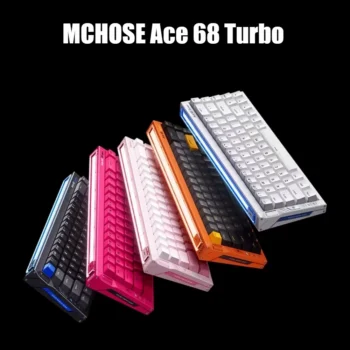

The MCHOSE ACE 68 Turbo Magnetic Keyboard is a premium 68-key Hall Effect gaming keyboard built for competitive players who want extremely fast wired input, adjustable actuation, Rapid Trigger control, advanced movement features, and a solid full-aluminum chassis. Unlike a conventional mechanical keyboard that relies on fixed contact points, the ACE 68 Turbo uses magnetic Hall Effect sensing to track key travel and let the user tune how individual keys activate and reset.
View MCHOSE ACE 68 Turbo Magnetic Keyboard
For U.S. gamers searching for a Hall Effect gaming keyboard, 16K polling keyboard, Rapid Trigger keyboard, magnetic switch gaming keyboard, compact esports keyboard, aluminum gaming keyboard, or 65 percent gaming keyboard for FPS play, the ACE 68 Turbo is designed to compete at the enthusiast end of the market. Its key strengths include a full CNC-machined aluminum case, 256K scan rate, 0.001 mm precision, adjustable 0.1–3.4 mm actuation, hot-swappable compatible magnetic switches, south-facing RGB, onboard memory, a physical Rapid Trigger profile button, a multifunction control knob, and MCHOSE M HUB software.
The exact performance specification depends on the switch configuration. MCHOSE currently lists a Gateron Magnetic Jade Pro version with up to 8K polling and 0.08 ms advertised latency, while the Mount Tai Magnetic Switch GT configuration supports up to 16K polling and 0.06 ms advertised latency. The 16K polling mode is listed for Windows, while macOS is limited to up to 8K. Buyers should therefore verify the selected switch and variation before checkout rather than assuming every ACE 68 Turbo has identical internal hardware.
This guide explains what the MCHOSE ACE 68 Turbo offers, how its Hall Effect technology differs from a traditional mechanical keyboard, what the 16K polling and 256K scan-rate specifications mean, how Rapid Trigger and advanced key functions work, which switch versions are available, how M HUB is used, and what U.S. buyers should check before purchasing.

MCHOSE ACE 68 Turbo Magnetic Keyboard Product Overview
The ACE 68 Turbo uses a 65% ANSI-style layout with 68 keys. It is compact enough to save substantial desk space while retaining arrow keys and a practical set of essential controls. Official dimensions are approximately 324 × 119 × 38 mm, and the keyboard weighs about 1,361 grams. That weight is much higher than many plastic compact keyboards because the Turbo uses a full CNC-machined aluminum shell.
The full-aluminum construction is a major distinction between the ACE 68 Turbo and lower-priced compact Hall Effect models. The extra mass can help the board stay planted during aggressive gaming and also gives it a more premium desktop feel. MCHOSE currently offers the Turbo in Cyber Black, Berry Red, Peachy Pink, Nova White, and Galaxy Orange, although exact switch and color combinations can vary.
MCHOSE ACE 68 Turbo Core Specifications
| Specification | ACE 68 Turbo Details |
|---|---|
| Layout | 65% ANSI, 68 keys |
| Case | Full CNC-machined aluminum |
| Switch Technology | Hall Effect magnetic switches |
| Switch Options | Gateron Magnetic Jade Pro or Mount Tai Magnetic Switch GT |
| Polling Rate | Up to 8K or 16K depending on configuration |
| Scan Rate | 256K |
| Precision | 0.001 mm |
| Advertised Latency | 0.08 ms or 0.06 ms depending on configuration |
| Actuation Range | 0.1–3.4 mm |
| Rapid Trigger Range | 0.001–3.4 mm |
| Lighting | South-facing RGB with dynamic light bar |
| Software | MCHOSE M HUB web and PC client |
| Connectivity | Wired USB-C |
| Onboard Memory | Supported |
| Dimensions | 324 × 119 × 38 mm |
| Weight | Approximately 1,361 g |
MCHOSE ACE 68 Turbo Is a Hall Effect Keyboard, Not a Conventional Mechanical Board
Some marketplace titles describe the ACE 68 Turbo as an esports mechanical keyboard, but its core switch technology is Hall Effect magnetic sensing. The keys still have physical switch mechanisms and familiar keyboard travel, but actuation is measured magnetically rather than through the standard electrical contact system used by conventional mechanical switches. That difference is what enables adjustable actuation and Rapid Trigger behavior.
MCHOSE ACE 68 Turbo Full CNC Aluminum Construction
The chassis is one of the most visible upgrades on the Turbo. MCHOSE uses a full CNC-machined aluminum shell rather than relying on a lightweight plastic outer case. This adds weight, rigidity, and a more premium feel on the desk.
MCHOSE ACE 68 Turbo Stability During Gaming
A heavier keyboard is less likely to slide during fast movement input, especially when the player uses aggressive tapping or keeps the board at an angle. The approximately 1.36 kg weight gives the ACE 68 Turbo a planted feel that suits fixed desktop gaming setups.
MCHOSE ACE 68 Turbo Is Less Portable Than Lightweight Plastic Keyboards
The tradeoff is portability. If you frequently carry your keyboard between home, work, school, or esports events, the additional aluminum weight will be noticeable. The Turbo makes the most sense for users who prioritize desk stability and premium construction over minimum carrying weight.

MCHOSE ACE 68 Turbo Hall Effect Magnetic Switch Technology
Hall Effect sensing is the technology that makes the ACE 68 Turbo highly configurable. Instead of waiting for a fixed contact point inside a traditional mechanical switch, the keyboard uses magnetic sensors to measure how far each supported switch travels.
This gives the firmware continuous position information and allows the user to set custom activation points. The keyboard can therefore respond differently depending on how deeply a key is pressed, making it possible to build a very sensitive gaming profile or a more deliberate typing profile without replacing the entire keyboard.
MCHOSE ACE 68 Turbo Adjustable Actuation
MCHOSE lists an actuation range from 0.1 to 3.4 mm. At 0.1 mm, a key activates very near the beginning of its travel. At a deeper value, more movement is required. This is useful because competitive movement keys and everyday typing keys do not always benefit from the same sensitivity.
A player might use shallow actuation on W, A, S, and D while using deeper thresholds on number keys, utility commands, reload, inventory, or other functions that should not activate from accidental contact. Per-key tuning is one of the biggest practical advantages of a Hall Effect gaming keyboard.
MCHOSE ACE 68 Turbo Extreme Sensitivity Should Be Tuned Gradually
The smallest possible value is not automatically the best setting. Very shallow actuation can make accidental presses more likely, particularly if the user rests fingers heavily on the keyboard. Start with moderate settings, test them in real gameplay, and lower the actuation distance gradually until movement feels faster without becoming unstable.
MCHOSE ACE 68 Turbo Rapid Trigger Explained
Rapid Trigger changes how a key resets after activation. On a conventional mechanical keyboard, a key usually must return to a fixed reset point before it can activate again. Hall Effect sensing allows the ACE 68 Turbo to track movement dynamically and reset based on the direction and distance of travel.
This can make repeated movement inputs feel more immediate. When the player begins lifting a key, the keyboard can release the input quickly instead of waiting for the switch to return to a traditional reset height. When the key is pressed again, it can react using the configured Rapid Trigger value.
MCHOSE ACE 68 Turbo 0.001 mm Rapid Trigger Precision
MCHOSE lists 0.001 mm precision and a Rapid Trigger range of 0.001–3.4 mm for the Turbo platform. This is an extremely fine configuration specification. It represents the sensing and tuning capability of the hardware and firmware, not a promise that every player will consciously notice a difference of one thousandth of a millimeter.
MCHOSE ACE 68 Turbo Rapid Trigger Is Useful for FPS Movement
Competitive shooters are one of the strongest use cases because movement often depends on quickly stopping, changing direction, or repeating small key taps. Rapid Trigger can reduce the physical reset distance required for those actions. Its usefulness still depends on the game, the player’s technique, and the selected settings.
MCHOSE ACE 68 Turbo 16K Polling Rate
The highest-spec ACE 68 Turbo configuration supports up to a 16,000Hz polling rate. Polling rate describes how frequently the keyboard can report information to the PC over USB. A 1000Hz keyboard reports at roughly one-millisecond intervals, while a 16K device can provide much shorter theoretical report intervals.
MCHOSE currently lists 1K, 2K, 4K, 8K, and 16K choices in M HUB, with 16K specifically available on the Mount Tai Magnetic Switch GT version. The Gateron Magnetic Jade Pro version is listed at up to 8K.
MCHOSE ACE 68 Turbo 16K Is Windows-Focused
MCHOSE states that 16K polling is available on Windows. On Mac, the supported maximum is listed at 8K. U.S. buyers who specifically want the keyboard for 16K testing should therefore plan to use a compatible Windows PC and the appropriate Turbo configuration.
MCHOSE ACE 68 Turbo 16K Does Not Guarantee a Visible Gaming Advantage
A higher polling rate reduces one part of the input chain, but actual gaming responsiveness also depends on CPU performance, USB handling, game engine behavior, frame rate, display refresh, GPU rendering, and monitor response. Players using high-refresh competitive setups are more likely to care about the difference than users playing at lower frame rates.

MCHOSE ACE 68 Turbo 256K Scan Rate and Low Latency
Scan rate refers to how quickly the keyboard checks its own switch state internally. MCHOSE lists a 256K scan rate across ACE 68 Turbo configurations, placing the board in its high-performance Hall Effect category.
MCHOSE ACE 68 Turbo 0.06 ms and 0.08 ms Versions
The Mount Tai Magnetic Switch GT configuration is listed with 0.06 ms advertised latency, while the Gateron Magnetic Jade Pro version is listed at 0.08 ms. These are device-side marketing specifications and should not be interpreted as total end-to-end latency from finger movement to visible action on a monitor.
MCHOSE ACE 68 Turbo Reduces Keyboard-Side Delay
The value of the Turbo is that the keyboard itself is designed not to become a major bottleneck in a high-performance setup. A strong CPU, high frame rate, low-latency rendering path, and high-refresh monitor are still necessary if the goal is to reduce the complete input-to-display chain.
MCHOSE ACE 68 Turbo Dual-Core and Single-Core Configurations
The internal controller differs by switch version. MCHOSE lists the Gateron Magnetic Jade Pro configuration with a single-core MCU and two-layer PCB, while the Mount Tai Magnetic Switch GT configuration uses a dual-core MCU and four-layer PCB.
MCHOSE ACE 68 Turbo Dual-Core Mount Tai GT Version
The Mount Tai GT configuration is the version associated with the maximum Turbo specifications: 16K polling, 0.06 ms advertised latency, four-layer PCB, next-generation Hall Effect sensors, and dual-core processing.
MCHOSE ACE 68 Turbo Jade Pro Version Remains a High-Performance Option
The Jade Pro configuration still provides 0.001 mm precision, 256K scanning, Rapid Trigger, adjustable actuation, Hall Effect sensing, and up to 8K polling. It should not be treated as a basic keyboard simply because it does not use the Turbo’s maximum 16K specification.
MCHOSE ACE 68 Turbo Physical RT Button
The ACE 68 Turbo includes an external physical Rapid Trigger button designed to make profile switching faster. MCHOSE states that the button supports three RT profiles, allowing players to move between stored trigger configurations without navigating through software every time.
MCHOSE ACE 68 Turbo Three Rapid Trigger Profiles
The physical indicator is synchronized with the driver, helping the user identify which onboard RT mode is active. This is useful for players who want separate sensitivity profiles for different games or for gaming and typing.
MCHOSE ACE 68 Turbo Physical Controls Reduce Software Dependence
Software remains essential for detailed configuration, but a dedicated hardware control makes everyday switching faster. Once profiles are prepared, the user can change the active behavior directly from the keyboard rather than repeatedly opening M HUB.
MCHOSE ACE 68 Turbo Multifunction Control Knob
In addition to the RT button, the Turbo includes a multifunction control knob. This gives the compact keyboard a physical control element that many small esports boards omit.
MCHOSE ACE 68 Turbo Compact Layout with Extra Physical Control
A 65% layout saves desk space, but reducing key count can also remove convenient dedicated controls. The multifunction knob helps recover some quick-access functionality without making the keyboard significantly wider.
MCHOSE ACE 68 Turbo Keeps the Main Gaming Area Compact
The keyboard still remains substantially narrower than a full-size model, leaving more room for the mouse. This is particularly useful for low-sensitivity FPS players who make large horizontal movements.

MCHOSE ACE 68 Turbo Advanced Key Functions
M HUB supports several advanced magnetic-key functions on the ACE 68 Turbo, including RS, SOCD, DKS, MT, TGL, and macros. These features use the keyboard’s sensing and software layers to create behavior beyond simple one-key, one-action input.
MCHOSE ACE 68 Turbo SOCD
SOCD controls what happens when two opposing directional inputs are pressed together. Depending on the selected rule, the keyboard can prioritize one input or cancel conflicting inputs. This can be useful for movement experimentation, but some competitive games and tournaments restrict certain SOCD behaviors.
MCHOSE ACE 68 Turbo RS
RS can prioritize a paired key based on how deeply it is pressed. If two configured keys are held at different depths, the deeper key can become the active input. This takes advantage of analog-like travel information from the magnetic sensors.
MCHOSE ACE 68 Turbo DKS
Dynamic Keystroke allows one key to perform multiple functions depending on travel. MCHOSE states that DKS can provide up to four functions on one key. That can be useful for advanced game commands or compact-layer customization.
MCHOSE ACE 68 Turbo MT and TGL
MT can assign separate behavior to a tap and a hold, while TGL can turn a configured continuous action on and off with repeated key presses. These tools can add flexibility to a small layout, although game rules should always be checked before using automated behavior in competition.
MCHOSE ACE 68 Turbo Advanced Features Should Be Organized by Profile
Complex customization is easier to manage when different tasks use different profiles. A competitive FPS profile, a general gaming profile, and a typing profile can each use appropriate trigger and remapping settings without forcing every behavior into one configuration.
MCHOSE ACE 68 Turbo M HUB Software
MCHOSE provides both a web-based driver and a PC client for the ACE 68 Turbo. M HUB controls trigger parameters, Rapid Trigger, key values, advanced functions, keyboard performance, lighting, firmware, macros, onboard configurations, and factory reset options.
MCHOSE ACE 68 Turbo Web Driver
The web driver can be opened in a compatible browser without installing a traditional application. MCHOSE recommends Chrome or Edge and requires the user to allow browser access to the keyboard as an HID device.
MCHOSE ACE 68 Turbo PC Client
The desktop client provides another way to access the same ecosystem of settings. MCHOSE recommends connecting the keyboard directly to the computer rather than through an external dock when configuring or troubleshooting the device.
MCHOSE ACE 68 Turbo Trigger Settings
Trigger travel, Rapid Trigger, and dead-zone parameters can be adjusted globally or for specific keys. This makes it possible to keep WASD extremely responsive while setting less frequently used keys deeper.
MCHOSE ACE 68 Turbo Includes Preset Configuration Styles
M HUB documentation lists Beginner, FPS, and Extreme-style presets. These provide useful starting points for users who are new to Hall Effect keyboards and do not yet know which actuation values feel comfortable.
MCHOSE ACE 68 Turbo Onboard Memory and Profiles
Onboard memory allows customized settings to remain associated with the keyboard. MCHOSE supports saving items such as key mappings, macros, lighting effects, and trigger travel into onboard configurations.
MCHOSE ACE 68 Turbo Profile Switching
Once an onboard profile has been saved, the user can carry the keyboard to another compatible computer without rebuilding every setting from the beginning. The physical RT control also makes movement-focused profile switching more convenient.
MCHOSE ACE 68 Turbo Configuration Export and Import
M HUB also supports exporting and importing configurations for the same model, along with configuration codes. This can be useful for keeping backups of carefully tuned profiles or sharing a setup between multiple ACE 68 Turbo users.
MCHOSE ACE 68 Turbo Adaptive Dynamic Calibration
Hall Effect keyboards rely on accurate measurement of magnetic switch travel. MCHOSE recommends keeping Adaptive Dynamic Calibration enabled because each key press can contribute to automatic calibration and improve sensing consistency.
MCHOSE ACE 68 Turbo Calibration After Switch Changes
If a supported switch type is changed, calibration becomes particularly important. Magnetic switches differ in geometry and magnetic characteristics, so the correct switch profile should be selected in M HUB.
MCHOSE ACE 68 Turbo Stability Mode
M HUB also includes a stability mode intended to improve behavior when extreme trigger settings cause unstable input. This can be useful for players experimenting with very small Rapid Trigger values who encounter accidental activations or inconsistent key behavior.

MCHOSE ACE 68 Turbo Hot-Swappable Magnetic Switches
The ACE 68 Turbo supports hot-swappable compatible magnetic switches. This makes it possible to replace supported switches without soldering and gives enthusiasts more room to experiment with switch feel.
MCHOSE ACE 68 Turbo Gateron Magnetic Jade Pro
The Gateron Magnetic Jade Pro configuration is listed with 0.001 mm precision, a 256K scan rate, up to 8K polling, and 0.08 ms advertised latency. It uses a single-core MCU and two-layer PCB according to the official comparison.
MCHOSE ACE 68 Turbo Mount Tai Magnetic Switch GT
The Mount Tai GT configuration is the maximum-performance option currently shown by MCHOSE. It uses a dual-core MCU, four-layer PCB, next-generation Hall Effect sensor design, up to 16K polling on Windows, and 0.06 ms advertised latency.
MCHOSE ACE 68 Turbo Does Not Accept Ordinary Mechanical Switches
Hall Effect hot-swap should not be confused with standard MX mechanical hot-swap. MCHOSE magnetic keyboards require compatible magnetic switches. Using unsupported conventional switches can cause calibration problems, abnormal triggering, or complete failure to register input.
MCHOSE ACE 68 Turbo RGB Lighting and Dynamic Light Bar
The Turbo uses south-facing RGB LEDs and adds a dynamic light bar. MCHOSE lists approximately 16 million customizable colors and music-reactive lighting features, giving the board a more visual presentation than many performance-first esports keyboards.
MCHOSE ACE 68 Turbo Music Sync Lighting
Music-reactive lighting can synchronize visual effects with audio activity. Users who prefer a restrained desktop can instead choose a static effect, reduce brightness, or disable the lighting entirely.
MCHOSE ACE 68 Turbo Lighting Shortcuts
The official quick-start guide lists Fn + T for turning the keyboard backlight and lightbox on or off. Other shortcuts control lighting color, effects, brightness, and animation speed, while M HUB provides more detailed visual customization.
MCHOSE ACE 68 Turbo Internal Acoustic Structure
MCHOSE equips the ACE 68 Turbo with an aluminum positioning plate and a multilayer internal dampening stack. The official specification includes sandwich foam, a fiber switch pad, PET sound-damping material, bottom foam, and a PET base pad.
MCHOSE ACE 68 Turbo Five-Layer HiFi Cushioning
The goal of the internal cushioning is to reduce unwanted resonance and create a more controlled typing sound. Performance keyboards can sometimes sound hollow because speed is prioritized over acoustics, so the additional dampening makes the Turbo more suitable for users who also care about feel and sound.
MCHOSE ACE 68 Turbo Sound Still Depends on Switch and Desk Setup
The final sound will vary with switch choice, keycaps, desk mat, typing force, room acoustics, and the surface under the keyboard. A full-aluminum case can also sound different from a plastic enclosure, even when internal foam is similar.

MCHOSE ACE 68 Turbo for FPS Gaming
The ACE 68 Turbo is particularly well matched to FPS gaming because its compact width, Rapid Trigger controls, adjustable actuation, and high polling options all focus on movement responsiveness.
MCHOSE ACE 68 Turbo for Counter-Strafing
In games where a player rapidly changes direction, a short release distance can help the keyboard stop registering one movement direction sooner. Adjustable actuation then lets the opposite input activate with minimal travel. The result can feel more responsive when properly tuned.
MCHOSE ACE 68 Turbo Cannot Replace Player Skill
Low-latency hardware cannot replace aim, positioning, map knowledge, communication, or movement practice. The value of the Turbo is in minimizing hardware-side friction and giving skilled players more control over how their keys behave.
MCHOSE ACE 68 Turbo for High-Refresh-Rate Gaming PCs
The highest polling specifications make the most sense when the rest of the gaming PC is also optimized for low latency. A high-refresh monitor, strong CPU, stable high frame rate, and responsive game engine help create the environment where very high polling rates are most relevant.
MCHOSE ACE 68 Turbo with 240Hz, 360Hz, and Faster Displays
Players using 240Hz, 360Hz, 480Hz, or similarly fast monitors are the audience most likely to care about minimizing every input interval. The keyboard will still work on ordinary systems, but a premium polling specification alone cannot transform a low-frame-rate setup into an esports-level experience.
MCHOSE ACE 68 Turbo Performance Should Be Tested on the User’s Own PC
If 16K introduces compatibility or system-overhead issues, lower polling options remain available. A stable 8K or 4K setting can be preferable to a maximum setting that does not behave consistently on a specific computer.
MCHOSE ACE 68 Turbo for Typing and Everyday Work
The keyboard is clearly gaming focused, but adjustable actuation makes it practical for everyday use. Users can create a deeper typing profile for writing, coding, schoolwork, browsing, and communication, then switch back to a more sensitive profile for gaming.
MCHOSE ACE 68 Turbo Typing Profile
If accidental letters appear while typing, increase the actuation distance on alphanumeric keys and reduce Rapid Trigger sensitivity. A gaming profile does not need to double as the ideal office profile.
MCHOSE ACE 68 Turbo Has No Dedicated Number Pad
The 65% layout is efficient for gaming but less convenient for people who perform heavy numeric data entry. Accountants, spreadsheet-heavy users, and finance professionals may prefer a separate numpad or a larger keyboard for work.
MCHOSE ACE 68 Turbo Windows and macOS Support
The Turbo supports both Windows and macOS keyboard modes. The official quick-start guide lists Fn + O for Windows mode and Fn + P for macOS mode. When macOS mode is selected, modifier behavior changes to better match the platform.
MCHOSE ACE 68 Turbo Windows Mode for 16K Polling
Windows users with the Mount Tai GT configuration can access the advertised maximum 16K polling option. This is one reason the Turbo is especially targeted at Windows-based competitive PC gaming.
MCHOSE ACE 68 Turbo macOS Maximum Polling Rate
MCHOSE lists Mac support up to 8K polling rather than 16K. Users should therefore buy the Turbo for its broader Hall Effect feature set rather than expecting identical maximum polling behavior across operating systems.
MCHOSE ACE 68 Turbo Wired USB-C Connectivity
The ACE 68 Turbo supports wired connection only. It does not provide Bluetooth or 2.4GHz wireless mode. This is consistent with its focus on high-rate competitive input, but it is an important limitation for users who want one keyboard for several wireless devices.
MCHOSE ACE 68 Turbo Direct USB Connection
MCHOSE recommends connecting the keyboard directly to the computer rather than through an external expansion dock when using the driver or troubleshooting detection. The official package includes the appropriate USB Type-C cable for the selected configuration.
MCHOSE ACE 68 Turbo Uses Different Included Cables by Configuration
The official specification lists an 8K cable with the Jade Pro configuration and a 16K cable with the Mount Tai GT version. Buyers should confirm that the correct cable is included with the specific variation ordered.
MCHOSE ACE 68 Turbo Initial Setup
Connect the Type-C end of the cable to the keyboard and the other end directly to the PC. When the keyboard lights up, the basic wired connection is active. The next step is to open M HUB if you want to configure Hall Effect behavior.
MCHOSE ACE 68 Turbo Beginner Configuration
New users should start with a preset or moderate actuation values rather than immediately selecting the most extreme sensitivity. Test WASD first, then tune other keys based on actual use.
MCHOSE ACE 68 Turbo Performance Configuration
Choose the polling rate appropriate for the hardware, verify the installed switch profile, enable Adaptive Dynamic Calibration, and test Rapid Trigger. A key-testing page is available through the driver ecosystem for checking individual input behavior.
MCHOSE ACE 68 Turbo Factory Reset
The Turbo uses a different reset shortcut from the standard ACE 68. MCHOSE’s current Turbo quick-start guide lists Fn + Space for restoring factory settings. The driver also provides a factory-reset option. Resetting clears personalized trigger parameters, mappings, macros, and related configurations.
MCHOSE ACE 68 Turbo Gateron Jade Pro vs Mount Tai GT
| Feature | Gateron Magnetic Jade Pro | Mount Tai Magnetic Switch GT |
|---|---|---|
| Precision | 0.001 mm | 0.001 mm |
| Scan Rate | 256K | 256K |
| Polling Rate | Up to 8K | Up to 16K on Windows |
| Advertised Latency | 0.08 ms | 0.06 ms |
| MCU | Single-core | Dual-core |
| PCB | Two-layer | Four-layer |
| Hall Sensor | Custom Hall Effect sensor | New-generation Hall Effect sensor |
| RT Range | 0.001–3.4 mm | 0.001–3.4 mm |
| Actuation | 0.1–3.4 mm | 0.1–3.4 mm |
| Connection | Wired | Wired |
MCHOSE ACE 68 Turbo Jade Pro Is the Strong 8K Option
The Jade Pro configuration still includes the core Turbo experience: full aluminum construction, 256K scanning, 0.001 mm precision, Rapid Trigger, advanced key functions, RGB, dynamic light bar, and M HUB customization. It is suitable for users who do not specifically need 16K polling.
MCHOSE ACE 68 Turbo Mount Tai GT Is the Maximum-Performance Version
The Mount Tai GT version is the configuration to target if 16K polling, dual-core processing, four-layer PCB construction, and the lowest advertised 0.06 ms device latency are priorities.
MCHOSE ACE 68 Turbo Buyers Should Confirm the Variation Before Checkout
Because marketplace pages can combine several colors and switches, read the selected variation carefully. Do not assume that an image or specification shown elsewhere on the page automatically applies to the specific switch placed in the cart.
MCHOSE ACE 68 Turbo Color Options
The current official color range includes Cyber Black, Berry Red, Peachy Pink, Nova White, and Galaxy Orange. These options make the keyboard suitable for both understated esports setups and more colorful gaming desks.
MCHOSE ACE 68 Turbo Cyber Black and Nova White
Cyber Black fits traditional dark gaming setups, while Nova White works naturally with minimalist white PC cases, mice, desk mats, and monitors.
MCHOSE ACE 68 Turbo Berry Red, Peachy Pink, and Galaxy Orange
These brighter finishes are intended for users who want the keyboard to stand out visually rather than blend into the desk. Exact coating process and keycap shine-through can vary by switch and color combination.
MCHOSE ACE 68 Turbo Keycap Transparency Varies
MCHOSE’s current configuration table shows both shine-through and non-shine-through keycap combinations. If illuminated legends matter to you, check the exact color and switch option rather than assuming every Turbo keycap is translucent.
MCHOSE ACE 68 Turbo Package Contents
The official package includes the ACE 68 Turbo Hall Effect keyboard, a function card, USB Type-C cable, key and switch puller, two spare switches, and a dust cover. The cable specification depends on whether the selected configuration is designed for 8K or 16K operation.
MCHOSE ACE 68 Turbo Spare Switches and Puller
Spare compatible switches make basic maintenance easier. The included puller can be used for keycaps and supported switch replacement without soldering.
MCHOSE ACE 68 Turbo Marketplace Bundles May Differ
Always compare the exact seller package with the official package list. Regional sellers can bundle accessories differently, and marketplace listings can change over time.
MCHOSE ACE 68 Turbo Cleaning and Maintenance
Disconnect the keyboard before cleaning. Use a soft microfiber cloth for the aluminum shell and a soft brush or carefully controlled compressed air for loose debris around the keys. Avoid introducing liquid into the switch or PCB area.
MCHOSE ACE 68 Turbo Keycap and Switch Removal
Use the included puller and lift components carefully rather than forcing them sideways. If a magnetic switch is replaced, verify that it is a supported model and recalibrate if necessary.
MCHOSE ACE 68 Turbo Is Not a Waterproof Keyboard
The aluminum exterior does not make the electronics waterproof. Keep drinks away from the board when possible. If a spill occurs, disconnect the keyboard immediately and do not continue using powered electronics while moisture may remain inside.
MCHOSE ACE 68 Turbo Advantages
- Full CNC-machined aluminum case.
- Compact 65% ANSI 68-key layout.
- Hall Effect magnetic switch technology.
- 0.001 mm precision.
- 256K scan rate.
- Up to 16K polling on the Mount Tai GT Windows configuration.
- Up to 8K polling on the Jade Pro configuration.
- 0.06 ms or 0.08 ms advertised device latency depending on version.
- Adjustable 0.1–3.4 mm actuation.
- Rapid Trigger range down to 0.001 mm.
- Physical RT button with three profiles.
- Multifunction control knob.
- SOCD, RS, DKS, MT, TGL, and macro functions.
- Hot-swappable compatible magnetic switches.
- South-facing RGB lighting.
- Dynamic RGB light bar.
- M HUB web and PC client support.
- Adaptive Dynamic Calibration.
- Onboard memory and profile support.
- Multilayer internal sound dampening.
MCHOSE ACE 68 Turbo Considerations Before Buying
- The keyboard is wired only.
- 16K polling requires the appropriate Mount Tai GT configuration and Windows.
- macOS is listed at up to 8K polling.
- The keyboard is relatively heavy at about 1.36 kg.
- There is no dedicated number pad.
- Extreme trigger settings can increase accidental input if poorly tuned.
- Magnetic hot-swap requires compatible magnetic switches rather than ordinary mechanical switches.
- Advanced SOCD and macro behavior may be restricted in some games or tournaments.
- The practical advantage of very high polling depends on the rest of the PC and display setup.
- Switch, keycap, MCU, PCB, and cable specifications vary by selected configuration.
MCHOSE ACE 68 Turbo Frequently Asked Questions
Is the MCHOSE ACE 68 Turbo a Hall Effect keyboard?
Yes. It uses magnetic Hall Effect switch sensing and supports adjustable actuation and Rapid Trigger.
How many keys does the MCHOSE ACE 68 Turbo have?
It uses a 65% ANSI layout with 68 keys.
Does the MCHOSE ACE 68 Turbo support 16K polling?
Yes, the Mount Tai Magnetic Switch GT configuration supports up to 16K polling on Windows. The Jade Pro configuration is listed at up to 8K.
Does 16K polling work on macOS?
MCHOSE states that macOS supports up to 8K polling rather than the full 16K maximum.
What is the ACE 68 Turbo scan rate?
MCHOSE lists a 256K scan rate.
What is the ACE 68 Turbo precision?
The official specification lists 0.001 mm precision.
What is the ACE 68 Turbo actuation range?
The adjustable actuation range is 0.1–3.4 mm.
What is the Rapid Trigger range?
MCHOSE lists a 0.001–3.4 mm Rapid Trigger range.
What is the ACE 68 Turbo latency?
The Mount Tai GT configuration is advertised at 0.06 ms, while the Gateron Magnetic Jade Pro configuration is listed at 0.08 ms.
Is the ACE 68 Turbo wireless?
No. It supports wired connectivity only.
Does the ACE 68 Turbo have Bluetooth?
No. Bluetooth is not listed for this model.
Does it have 2.4GHz wireless?
No. The current Turbo is a wired esports keyboard.
Does the ACE 68 Turbo use USB-C?
Yes. The keyboard connects through USB Type-C.
Can the switches be replaced?
Yes. The keyboard supports hot-swappable compatible magnetic switches.
Can I install ordinary MX mechanical switches?
No. Hall Effect boards require compatible magnetic switches and should not be treated like conventional 3-pin or 5-pin mechanical hot-swap keyboards.
Does the ACE 68 Turbo have RGB?
Yes. It has south-facing RGB LEDs and a dynamic light bar with customizable effects.
Does the ACE 68 Turbo have onboard memory?
Yes. MCHOSE lists onboard memory and profile support.
What software does the ACE 68 Turbo use?
It uses MCHOSE M HUB through either the web driver or PC client.
Does the ACE 68 Turbo support SOCD?
Yes. It supports SOCD along with RS, DKS, MT, TGL, and macros.
Does the ACE 68 Turbo have a physical Rapid Trigger button?
Yes. MCHOSE includes a physical RT control that supports switching among three RT profiles.
Does the ACE 68 Turbo have a control knob?
Yes. The keyboard includes a multifunction control knob.
Can I use the ACE 68 Turbo with a Mac?
Yes. The keyboard includes a macOS mode, but the maximum listed polling rate on Mac is 8K.
How do I switch to Windows mode?
Press Fn + O according to MCHOSE’s current Turbo quick-start guide.
How do I switch to macOS mode?
Press Fn + P.
How do I factory reset the ACE 68 Turbo?
MCHOSE lists Fn + Space as the Turbo factory-reset shortcut. A factory reset can also be performed through the driver.
What are the ACE 68 Turbo dimensions?
The official dimensions are approximately 324 × 119 × 38 mm.
How much does the ACE 68 Turbo weigh?
MCHOSE lists the keyboard at approximately 1,361 grams.
Is the ACE 68 Turbo good for FPS gaming?
Yes. Its compact layout, Rapid Trigger, adjustable actuation, high scan rate, very high polling options, and advanced movement functions make competitive FPS gaming a primary use case.
Is the ACE 68 Turbo good for typing?
It can be. A separate typing profile with deeper actuation can make the keyboard more comfortable for writing and productivity.
Is the ACE 68 Turbo worth buying?
It can be a strong option for gamers who specifically want a premium aluminum Hall Effect board with 0.001 mm precision, 256K scanning, advanced magnetic key functions, and up to 16K polling on the highest configuration.
MCHOSE ACE 68 Turbo Final Buying Verdict
The MCHOSE ACE 68 Turbo Magnetic Keyboard is a significant step above a basic compact gaming keyboard. It combines Hall Effect sensing with a heavy full-aluminum chassis, extremely fine trigger tuning, high scan rates, advanced software functions, physical profile controls, and premium RGB presentation.
Its biggest headline specification is the maximum 16K polling rate, but the more meaningful value comes from the full combination of features. Adjustable actuation lets each key be tuned to the task. Rapid Trigger reduces dependence on fixed reset points. A 256K scan rate keeps internal key sensing fast, while the 0.001 mm precision specification gives the software extremely fine control over trigger behavior.
The two main switch configurations should be understood before purchase. The Gateron Magnetic Jade Pro version is an 8K option with 0.08 ms advertised latency, single-core MCU, and two-layer PCB. The Mount Tai Magnetic Switch GT version is the maximum-performance configuration with dual-core processing, four-layer PCB, next-generation Hall sensors, up to 16K polling on Windows, and 0.06 ms advertised latency.
For many gamers, the Jade Pro version will already provide more performance than they practically need. Competitive enthusiasts who specifically want the strongest specification should focus on the Mount Tai GT version and confirm that the appropriate 16K cable is included.
The full CNC-aluminum shell gives the Turbo a premium physical character that many affordable Hall Effect boards cannot match. Its roughly 1.36 kg weight helps it remain stable on a desk, while the 65% layout keeps the overall footprint compact enough for large mouse movements.
The physical RT button is another useful distinction. Instead of requiring software every time the player wants to change trigger behavior, three RT profiles can be switched directly from the keyboard. This is practical for users who alternate between competitive gaming, general gaming, and typing.
The multifunction knob, dynamic light bar, south-facing RGB, and multiple case colors also make the board more visually polished than a purely utilitarian esports keyboard. Users who care about both competitive performance and desktop aesthetics may find that balance attractive.
M HUB adds substantial depth. It supports actuation tuning, Rapid Trigger, dead zones, SOCD, RS, DKS, MT, TGL, macros, remapping, polling-rate control, lighting, calibration, firmware updates, configuration import and export, and onboard profiles. The Turbo is therefore best suited to users who are willing to spend time configuring the keyboard rather than leaving every setting at its default.
The internal acoustic treatment also deserves attention. An aluminum positioning plate combined with multiple foam and PET layers is intended to reduce unwanted resonance and make the keyboard more pleasant for everyday typing. Sound will still vary with the chosen switch and desk setup, but the internal structure shows that MCHOSE is not treating acoustics as an afterthought.
There are several compromises. The keyboard is wired only, so it is not the right choice for users who need Bluetooth or 2.4GHz multi-device connectivity. Its aluminum construction also makes it significantly heavier than a typical compact gaming board. The 65% layout saves desk space but removes a dedicated number pad and requires secondary shortcuts for some functions.
The 16K specification should also be viewed in context. It is available on the Mount Tai GT version under Windows, while Mac support tops out at 8K. The real-world advantage of 16K depends on the PC, game, frame rate, USB subsystem, and display. Buyers should not choose the Turbo solely because 16K is a larger number than 8K.
For U.S. shoppers searching for a MCHOSE ACE 68 Turbo magnetic keyboard, 16K polling gaming keyboard, Hall Effect gaming keyboard, Rapid Trigger keyboard, aluminum esports keyboard, 65 percent gaming keyboard, magnetic switch gaming keyboard, or FPS gaming keyboard, the ACE 68 Turbo is a compelling premium option.
The strongest buyer profile is a competitive PC gamer, Hall Effect keyboard enthusiast, or high-refresh-rate user who values fine trigger tuning and premium construction. Someone looking only for basic office typing or wireless convenience will probably not use enough of the Turbo’s feature set to justify choosing it over a simpler keyboard.
Before ordering, confirm the switch, color, keycap type, polling-rate ceiling, cable, MCU/PCB configuration, and seller package for the exact variation selected. Marketplace listings can combine multiple Turbo configurations, so the maximum specification shown on the page may not apply to every option.
If the chosen configuration matches your priorities, the ACE 68 Turbo offers an unusually complete combination of Hall Effect responsiveness, high polling, full-aluminum construction, physical profile controls, software flexibility, and competitive gaming features.
MCHOSE ACE 68 Turbo Shop and Compare
Check the exact switch variation before checkout. Choose the Mount Tai GT version if the full 16K Windows polling specification is important, or compare the Jade Pro version if 8K performance already meets your needs.