
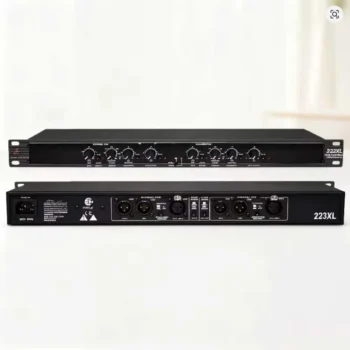

dbx 223XL 234XL Frequency Divider Crossover Complete Guide
A professional PA system depends on more than powerful amplifiers and high-output speakers. The audio signal must also reach the correct loudspeaker driver at the appropriate frequency range. Sending deep bass to a high-frequency horn or allowing unnecessary high-frequency information into a dedicated subwoofer system can reduce efficiency, complicate system tuning, and prevent individual loudspeakers from performing the jobs they were designed to handle.
The dbx 223XL 234XL 2/3 Way Frequency Divider product family addresses this challenge with professional active crossover processing designed for live sound, portable PA systems, installed sound, DJ rigs, music venues, houses of worship, rehearsal rooms, clubs, and other multi-amplifier loudspeaker systems.
For U.S. shoppers searching for a dbx 223XL crossover, dbx 234XL crossover, professional audio frequency divider, 2 way active crossover, 3 way speaker crossover, PA system crossover, XLR electronic crossover, or rack mount speaker crossover, the 223XL and 234XL designs remain recognizable examples of straightforward analog frequency management.
The two models are related but are not identical. The 223XL is designed for stereo 2-way or mono 3-way operation, while the 234XL provides stereo 2-way, stereo 3-way, or mono 4-way crossover configurations. Both XL models use balanced XLR connectors and 24 dB-per-octave Linkwitz-Riley crossover filters.
This detailed guide explains how active crossovers work, the differences between the 223XL and 234XL, XLR connections, crossover-frequency adjustment, x10 range switching, low-cut filtering, phase inversion, LF summing, system wiring, amplifier configuration, subwoofer integration, gain structure, rack installation, troubleshooting, and the most important questions to consider before purchasing.

What Is the dbx 223XL 234XL Frequency Divider?
The dbx 223XL and 234XL are active electronic crossovers. An active crossover receives a full-range line-level audio signal and divides it into separate frequency bands before those signals reach the power amplifiers.
Each resulting output can then be connected to an amplifier channel dedicated to the appropriate loudspeaker section.
Why Frequency Division Matters
A woofer is designed to reproduce lower frequencies efficiently. A midrange driver handles a different part of the spectrum, while a compression driver or tweeter is intended for higher frequencies.
A crossover allows those drivers to concentrate on their intended frequency ranges rather than asking every driver to reproduce the entire audio spectrum.
Active Crossovers Operate Before the Power Amplifiers
The 223XL and 234XL work at line level. In a typical system, the mixer or system processor sends audio to the crossover, the crossover divides the signal, and the separate outputs feed the appropriate amplifier channels.
dbx 223XL vs 234XL at a Glance
| Feature | dbx 223XL | dbx 234XL |
|---|---|---|
| Stereo 2-Way | Yes | Yes |
| Stereo 3-Way | No | Yes |
| Mono 3-Way | Yes | Not its primary mono configuration |
| Mono 4-Way | No | Yes |
| Input Connectors | XLR | XLR |
| Output Connectors | XLR | XLR |
| Crossover Filter | Linkwitz-Riley 24 dB/octave | Linkwitz-Riley 24 dB/octave |
| 40 Hz Low Cut | Yes | Yes |
| x10 Range Switch | Yes | Yes |
| Phase Invert | Yes | Yes |
| LF Sum | Yes | Yes |
| Rack Format | 19-inch, 1U | 19-inch, 1U |
Choose the 223XL for Simpler Two-Way Systems
The 223XL is particularly appropriate when the main requirement is a stereo two-way PA system, such as subwoofer plus full-range top operation, or a mono three-way loudspeaker system.
Choose the 234XL for More Complex Systems
The 234XL provides additional routing flexibility for stereo three-way systems or a mono four-way configuration where more frequency bands are required.
Watch the dbx 223XL 234XL Crossover Video
Front- and rear-panel photographs are helpful, but video makes it easier to understand the physical controls, rack format, connectors, knobs, and general construction of the unit.
What to Look for in the Product Video
Examine the crossover-frequency controls, channel input levels, low-cut switches, output-level controls, phase buttons, mode indicators, rear XLR connectors, power connection, and mode-selection switches.
Confirm the Exact Model Before Ordering
The 223XL and 234XL share a similar visual style but support different system configurations. Make sure the model selected at checkout matches the routing requirements of your PA system.
How an Active Audio Crossover Works
An active crossover divides the audio spectrum electronically before amplification.
A Two-Way Crossover Creates Two Frequency Bands
In a typical stereo two-way system, frequencies below the selected crossover point are sent to the low-frequency outputs while frequencies above the selected point are sent to the high-frequency outputs.
Example of a Two-Way PA System
A mixer can feed the crossover, with the low outputs feeding the amplifier that powers subwoofers and the high outputs feeding the amplifier that powers the main top cabinets.
A Three-Way Crossover Creates Three Bands
A three-way system separates the signal into low, mid, and high frequency ranges.
Why Three-Way Systems Need More Amplification Channels
Each band generally needs its own amplifier path and appropriate loudspeaker driver section. That makes wiring and tuning more complex than a basic two-way setup.
dbx 223XL Stereo 2-Way Operation
Stereo two-way mode is one of the most straightforward applications for the 223XL.
Left Channel Is Divided Into Low and High
The left mixer signal enters one crossover channel and is split between low-frequency and high-frequency outputs.
Right Channel Is Divided the Same Way
The second crossover channel performs the same function for the right side of the stereo mix.
Four Amplifier Paths May Be Used
Depending on amplifier configuration, the system typically requires separate amplification for left low, left high, right low, and right high loudspeaker sections.

dbx 223XL Mono 3-Way Operation
The 223XL can also be configured as a mono three-way crossover.
The Input Is Divided Into Low, Mid, and High Bands
This configuration is useful when one mono signal needs to feed three separate driver ranges.
Typical Three-Way Loudspeaker Sections
A system might use large woofers for bass, dedicated midrange drivers for vocal and instrument fundamentals, and compression drivers for high frequencies.
dbx 234XL Stereo 2-Way Operation
The 234XL can also run as a conventional stereo two-way crossover.
Why Use a 234XL in a Two-Way System?
A buyer may choose the 234XL even when initially operating only a two-way system because the unit provides additional configuration capability for future expansion.
Future System Changes May Be Easier
If the PA later moves to stereo three-way operation, the 234XL already supports the additional crossover band.
dbx 234XL Stereo 3-Way Operation
Stereo three-way mode is one of the main reasons to choose the 234XL.
Each Stereo Channel Is Split Into Three Bands
Left and right signals are each separated into low, mid, and high outputs.
Useful for Multi-Driver Professional PA Systems
This configuration can support systems where low-frequency enclosures, midrange cabinets or drivers, and high-frequency horns each receive their own frequency band.
More Bands Require Careful System Planning
Amplifier gain, crossover frequencies, driver sensitivity, polarity, delay, loudspeaker placement, and maximum power handling should all be considered when configuring a three-way system.
dbx 234XL Mono 4-Way Operation
The 234XL adds the ability to operate as a mono four-way crossover.
Four Frequency Bands Are Created
The signal can be divided into low, low-mid, high-mid, and high frequency sections.
Best Suited to Specialized Systems
Mono four-way operation is more complex than typical mobile DJ or small club systems and is generally most useful when multiple dedicated driver ranges are intentionally designed into the sound system.
What Is a Linkwitz-Riley Crossover Filter?
The dbx 223XL and 234XL use 24 dB-per-octave Linkwitz-Riley crossover filters.
The Slope Controls How Quickly Frequencies Roll Off
A 24 dB-per-octave filter reduces signal level relatively steeply outside the intended passband.
Why Steeper Filtering Can Be Useful
A steeper crossover slope helps limit how much unwanted frequency content reaches a driver beyond its intended operating range.
Why 24 dB per Octave Is Common in Professional Crossovers
Professional sound systems often require predictable frequency division and controlled overlap between loudspeaker sections.
It Helps Separate Driver Responsibilities
Woofers can focus on low frequencies while midrange and high-frequency drivers receive the bands they are designed to reproduce.
Crossover Settings Still Must Match the Loudspeakers
The filter type does not automatically determine the correct crossover frequency. Use loudspeaker manufacturer recommendations and system-design information when choosing the crossover point.
Understanding the Crossover Frequency Controls
The crossover-frequency knob determines where one frequency band transitions into another.
223XL Stereo Mode Range
The official specification lists a low/high crossover range of approximately 45 to 960 Hz in the normal range.
x10 Extends the Range
Activating the x10 range switch multiplies the corresponding front-panel frequency markings by ten, creating an approximate range of 450 Hz to 9.6 kHz.
Always Confirm the x10 Position
Setting a knob to what appears to be 100 Hz while the x10 switch is active would produce a very different result. Confirm the rear-panel range setting before powering the loudspeaker system at normal operating level.
234XL Crossover Frequency Ranges
The 234XL supports the additional frequency boundaries required by stereo three-way and mono four-way systems.
Low-Frequency Crossover Controls
The low crossover range can operate around 45 to 960 Hz or 450 Hz to 9.6 kHz when the x10 range is engaged.
Mid-to-High Crossover Range
The dedicated higher crossover sections support frequencies extending into approximately the 450 Hz to 9.6 kHz region.
Use Driver Specifications as the Starting Point
Do not select crossover points based solely on what sounds loudest. The safe operating ranges of the loudspeaker drivers should guide initial settings.

What Does the x10 Range Switch Do?
The x10 switch expands the crossover-frequency range by multiplying the front-panel frequency setting by ten.
Why the Switch Is Located on the Rear Panel
System-mode and range switches are settings that normally should not be changed accidentally during a performance.
Changing the Range Can Radically Alter the System
A crossover point intended for a subwoofer may suddenly move into the midrange if the switch is changed incorrectly. Lower amplifier levels before changing system configuration.
40 Hz Low-Cut Filter Explained
The units provide a 40 Hz low-cut function using a 12 dB-per-octave Butterworth high-pass filter.
Why Remove Very Low Frequencies?
Extremely low-frequency energy can consume amplifier and loudspeaker excursion even when that content provides little useful output in a particular speaker system.
Low Cut Is Not Appropriate for Every System
Some subwoofer systems are intentionally designed to reproduce frequencies around or below 40 Hz. Use the switch according to loudspeaker capability, application, and system-design goals.
Phase Invert Controls Explained
The 223XL and 234XL provide phase-invert controls on their outputs.
What Phase Inversion Does
The control reverses signal polarity at the selected output.
Why This Can Be Useful
Polarity relationships between drivers can affect cancellation and summation near crossover regions. A phase-invert control can be useful during system setup, although proper measurement is preferable to random switching.
Low-Frequency Sum Function
The LF Sum function allows low-frequency information to be combined for mono subwoofer operation.
Why Mono Subwoofer Systems Are Common
Many PA systems use left and right high-frequency or full-range cabinets while feeding subwoofers from a combined mono low-frequency signal.
LF Sum Can Simplify Certain Subwoofer Configurations
The function can be useful when the system uses a centralized or mono subwoofer array rather than independent left and right low-frequency channels.
Individual Output Level Controls
The crossover provides output-level adjustment for the different frequency bands.
Why Level Matching Is Necessary
A subwoofer, midrange cabinet, and high-frequency horn may have different amplifier gains and sensitivities.
Do Not Use Crossover Gain Controls as a Substitute for System Design
Output controls are useful for level matching, but speaker sensitivity, amplifier power, DSP settings, and acoustic placement should also be considered.
Balanced XLR Inputs and Outputs
The XL versions use XLR connectors for input and output connections.
Balanced Connections Are Common in Professional Audio
Balanced wiring is widely used in live sound because it helps reject noise that can enter long cable runs.
Use Proper Professional Audio Cables
Damaged cables, incorrect adapters, poorly soldered connectors, or unbalanced wiring can introduce hum, noise, or unreliable signal paths.
223XL and 234XL Input Specifications
Official dbx specifications describe electronically balanced or unbalanced RF-filtered inputs with XLR connectors.
High Input Impedance
The input impedance is specified above 50 kΩ balanced and above 25 kΩ unbalanced.
Designed for Line-Level Audio
The crossover should be connected within a professional line-level signal chain rather than directly to passive loudspeaker outputs from a power amplifier.
Professional Output Connections
The XLR outputs feed the separate amplifier channels or downstream processing associated with each frequency band.
Label Cables Clearly
In a three-way or four-way system, confusing low, mid, and high output cables can potentially send inappropriate frequency bands to the wrong drivers.
Use a Consistent Rack Wiring Scheme
Color coding or permanent cable labels can make setup faster and reduce routing mistakes during live events.

Typical Stereo Two-Way PA Signal Chain
A common setup might follow this basic structure:
Mixer → dbx crossover → low-frequency amplifier → subwoofers
Mixer → dbx crossover → high-frequency amplifier → main speakers
Left and Right Channels Remain Separate
In normal stereo two-way mode, each side has its own low and high outputs.
LF Sum Can Change the Subwoofer Configuration
If mono low-frequency operation is preferred, use the LF Sum feature according to the manual and system wiring requirements.
Typical Stereo Three-Way PA Signal Chain
A 234XL stereo three-way configuration divides each stereo side into low, mid, and high signals.
Low Outputs Feed Low-Frequency Amplification
These channels normally power woofers or subwoofer sections.
Mid Outputs Feed Midrange Amplification
These channels operate the dedicated middle-frequency loudspeakers.
High Outputs Feed High-Frequency Amplification
High-frequency outputs normally feed the amplifier channels driving horns or tweeters.
Six Amplified Signal Paths May Be Required
A full stereo three-way system can require low, mid, and high amplifier channels for both left and right sides.
Where Should the Crossover Go in the Audio Rack?
Signal flow is more important than the physical rack position, but organized placement simplifies operation.
Place It Near Related System Processing
Many engineers group equalizers, system processors, compressors, crossovers, and loudspeaker-management equipment in logical rack sections.
Keep Power Amplifiers Ventilated
Do not block amplifier airflow simply to place the crossover immediately beside them. Follow equipment ventilation requirements.
1U Rackmount Design
The 223XL and 234XL fit a standard 19-inch professional equipment rack and occupy approximately one rack unit of vertical space.
Approximate Dimensions
Official documentation lists approximately 1.75 inches high, 19 inches wide, and 6.9 inches deep.
Check Rack Depth for Connectors
Allow additional rear clearance for XLR plugs and the AC power cable rather than using the chassis depth alone.
223XL and 234XL Weight
The 223XL is listed at approximately 3.7 pounds, while the 234XL is approximately 4.0 pounds.
Lightweight Compared With Power Amplifiers
The crossover adds relatively little weight to a professional audio rack compared with large amplifiers.
Secure the Rack During Transportation
Even lightweight processors should be mounted properly when used in mobile DJ, touring, or rental systems.
Internal Power Supply and IEC Connection
The crossover family uses an internal power supply rather than relying on an external wall adapter.
IEC Power Connection
The standard power connector simplifies integration into many professional audio racks.
Verify Voltage Before Powering the Unit
Different regional versions can be designed for different AC voltages. U.S. buyers should verify that the exact unit being purchased is appropriate for their local 120V power environment before connecting it.
Power Consumption
Official specifications list approximately 15 watts of power consumption.
Low Power Compared With Amplifiers
The crossover itself uses very little power compared with the power amplifiers in a PA system.
Use Proper Power Distribution
A professional rack should still use appropriate grounding, power distribution, circuit capacity, and electrical safety practices.
Frequency Response and Bandwidth
The official dbx specifications describe wide audio performance suitable for professional sound applications.
Audio Bandwidth
The specified bandwidth covers approximately 20 Hz to 20 kHz within a very narrow tolerance.
Extended Frequency Response
The broader response extends beyond the normal human audio band according to the manufacturer’s specification.
Why This Matters
A crossover should divide the intended audio signal without introducing an unnecessarily narrow overall system bandwidth.
Dynamic Range and Low Distortion
The official model documentation describes professional dynamic-range and distortion performance.
Dynamic Range Supports Live Sound
A wide dynamic range helps the processor handle substantial differences between quiet and loud program material.
Gain Structure Still Matters
Even excellent electronic specifications cannot compensate for a mixer output that is clipping or amplifier inputs that are badly misadjusted.
How to Set Input Gain
Proper gain structure begins at the source.
Start With a Clean Mixer Signal
Avoid clipping channels, buses, or the main mix.
Set Crossover Input Levels Conservatively
Follow the manual and allow adequate headroom.
Optimize the Complete Signal Chain
Mixer output, crossover input, crossover output, amplifier sensitivity, and loudspeaker capability should all work together.
How to Choose a Starting Crossover Frequency
The loudspeaker manufacturer’s recommendation should usually be the first reference.
Subwoofer and Top Systems
Many professional subwoofer-plus-top systems use crossover points somewhere in the general bass region, but the correct value depends entirely on the speakers.
Three-Way Systems
Both the low-to-mid and mid-to-high crossover points must match the useful operating ranges of the selected drivers.
Do Not Copy an Arbitrary Internet Setting
A crossover frequency that works for one speaker model can be inappropriate for another cabinet with different drivers and horn geometry.
Why Speaker Specifications Should Guide Setup
Drivers Have Different Operating Ranges
A compression driver may not tolerate the same low frequencies as a large cone driver.
Cabinet Design Matters
Enclosures, horns, ports, and acoustic loading affect useful frequency response.
Use Manufacturer Data When Available
Recommended crossover points and minimum crossover frequencies can protect system performance and reduce guesswork.
Using the dbx Crossover With Subwoofers
Subwoofer integration is one of the most common reasons to add an active crossover to a PA system.
Low Frequencies Go to the Subwoofer Amplifier
The crossover sends the bass band to the amplification connected to the subs.
Higher Frequencies Go to the Main Speakers
The top cabinets no longer need to reproduce the same deep bass range when the system is configured appropriately.
This Can Improve System Efficiency
Drivers and amplifiers can concentrate on their intended frequency ranges instead of duplicating unnecessary bandwidth.
Using LF Sum With Subwoofers
Some systems operate subwoofers in mono even though the main speakers remain stereo.
Why Bass Is Often Summed
Many live sound systems prioritize centralized low-frequency coverage and amplifier efficiency over stereo separation in the deepest frequency range.
Check Wiring Carefully After Enabling LF Sum
The available outputs and channel behavior can change depending on the operating mode. Follow the manual instead of assuming every low output remains active.
Using the Crossover for DJ Sound Systems
DJs using separate subwoofers and full-range tops can benefit from an analog active crossover when their speakers or amplifiers do not already provide suitable DSP crossover functions.
Useful for Older Professional Amplifier Racks
Traditional systems often use standalone crossovers between the mixer and amplifiers.
Modern Powered Speakers May Already Include DSP
If your active speakers and subwoofers provide internal crossover processing, adding another analog crossover may be unnecessary or require careful integration.
Using the Crossover for Live Bands
Live music places significant demands on PA systems because vocals, drums, guitars, bass, keyboards, and playback sources can occupy a wide frequency range.
Frequency Division Helps Organize Amplification
Separate loudspeaker sections can handle the parts of the spectrum for which they were designed.
System Tuning Still Requires Listening and Measurement
A crossover alone does not correct room acoustics, speaker delay, equalization problems, or poor loudspeaker placement.
Using the Crossover in Houses of Worship
Churches and worship venues often operate permanently installed multi-amplifier loudspeaker systems.
Analog Controls Can Be Easy to Understand
Dedicated knobs and switches can provide straightforward access without requiring software.
Protect Critical Settings
Rear-panel mode and x10 switches should not be changed casually once the system has been professionally configured.
Using the Crossover in Clubs and Venues
Fixed venue systems may use separate subwoofer, midrange, and high-frequency amplification.
Rack Installation Keeps Processing Organized
The 1U chassis integrates easily into traditional professional audio racks.
Document the Configuration
Recording crossover points, output levels, polarity settings, and amplifier gain positions makes maintenance much easier.

Analog Crossover vs Digital Speaker Processor
Modern digital loudspeaker processors offer EQ, delay, limiting, routing, and crossover functionality in one device. Analog crossovers use a simpler dedicated approach.
Advantages of an Analog Crossover
Controls are immediate, operation does not require a computer, and basic signal flow can be easy to understand.
Advantages of Digital DSP
Digital processors can offer precise delay, parametric EQ, limiters, presets, remote control, and advanced routing.
Choose According to System Requirements
A straightforward two-way amplifier rack may need only a dedicated crossover, while a large modern touring system may benefit substantially from full DSP management.
dbx 223XL vs Modern dbx 223xs
The classic XL-series model should not be confused with later xs-series products.
Both Families Use Professional Crossover Concepts
dbx continues to offer comparable stereo two-way and mono three-way crossover functionality in its current crossover lineup.
Confirm the Exact Model Being Purchased
Front-panel appearance, production era, specifications, warranty status, and availability can differ between XL and xs models.
dbx 234XL vs Modern dbx 234xs
The 234XL is a legacy design for stereo two-way, stereo three-way, and mono four-way systems.
The 234xs Continues Similar Functional Positioning
Current dbx product families still include a crossover designed for stereo two/three-way and mono four-way operation with XLR connections.
Do Not Assume Accessories or Documentation Are Identical
Always use the manual for the exact model and revision in your rack.
Important Note About Legacy XL Models
Official dbx support information continues to provide documentation for the 223XL and 234XL, while the 234XL is listed by dbx as a discontinued legacy model.
Why This Matters When Buying Online
Online marketplace inventory can include older stock, used units, refurbished equipment, or products described as compatible with a legacy design.
Verify the Exact Unit You Are Purchasing
If brand authenticity, factory warranty, manufacturing origin, or production date is important, review the seller information and photographs carefully before checkout.
Common Crossover Setup Mistakes
Using the Wrong Mode
A system wired for stereo two-way operation will not behave correctly if the processor is switched to another configuration.
Forgetting the x10 Switch
This can place the crossover frequency dramatically higher than intended.
Connecting Outputs to the Wrong Amplifiers
Sending a high-frequency output to a subwoofer amplifier or a low-frequency output to a horn amplifier can create serious performance problems.
Changing Mode While the System Is Loud
Major routing changes should be made with amplifier levels reduced or equipment powered down according to safe operating procedures.
Setting Crossovers Without Speaker Data
Random crossover settings can produce frequency gaps, excessive overlap, poor tonal balance, or inappropriate driver operation.
Why You Should Label the Amplifier Rack
Label Low, Mid, and High Outputs
This helps prevent connection mistakes during setup.
Label Left and Right Channels
Stereo systems become easier to troubleshoot.
Document x10 and Mode Settings
A small rack diagram can save significant time if the system is transported, serviced, or operated by multiple engineers.
Troubleshooting No Bass Output
Check the Low Output Connection
Verify the correct XLR cable is connected to the low-frequency amplifier.
Check LF Sum Mode
Some outputs may behave differently when the low-frequency sum function is active.
Check Amplifier and Speaker Connections
The crossover may be working correctly even when a downstream amplifier channel is muted or disconnected.
Check the Crossover Frequency
An inappropriate setting can make the subwoofer band much narrower than expected.
Troubleshooting Weak High Frequencies
Verify the High Output Level
Check that the relevant output control has not been reduced excessively.
Check Phase and Wiring
Polarity problems can produce unexpected acoustic cancellation around crossover regions.
Inspect the High-Frequency Amplifier and Drivers
Do not assume the crossover is responsible for every system problem.
Troubleshooting Hum or Noise
Check Balanced Cables
Damaged XLR cables can introduce noise.
Review Grounding and Power Distribution
Professional audio racks should use appropriate electrical practices.
Separate Audio and High-Current Power Cables Where Practical
Good cable management can reduce unnecessary interference problems.
Test Components Systematically
Isolate the mixer, crossover, amplifier, and cables one stage at a time rather than replacing random equipment.
Advantages of the dbx 223XL 234XL Crossover Family
- Professional analog active crossover design
- Balanced XLR inputs and outputs on XL models
- 223XL supports stereo 2-way operation
- 223XL supports mono 3-way operation
- 234XL supports stereo 2-way operation
- 234XL supports stereo 3-way operation
- 234XL supports mono 4-way operation
- 24 dB-per-octave Linkwitz-Riley filters
- 40 Hz low-cut filter
- x10 frequency-range switches
- Phase-invert controls
- Low-frequency sum function
- Individual band output-level controls
- Standard 19-inch rack format
- Compact 1U chassis
- Internal power supply
- IEC power connection
- Suitable for traditional multi-amplifier PA systems
- Useful for subwoofer and top-speaker integration
- Direct physical controls without software
Important Considerations
- The 223XL and 234XL support different crossover configurations
- The 234XL is officially categorized as a discontinued legacy dbx model
- Verify exact product authenticity and seller condition when purchasing marketplace inventory
- Confirm AC voltage before powering the unit
- Check the rear x10 switches before setting crossover frequencies
- Match crossover points to loudspeaker specifications
- A crossover does not replace EQ, delay, or speaker limiting when those functions are required
- Active powered speakers may already contain crossover DSP
- Separate amplifier channels are required for the different frequency bands
- Incorrect wiring can send the wrong frequency band to a driver
- System changes should be made carefully with amplifier levels reduced
Who Gets the Most Value?
The ideal buyer operates a traditional professional audio system with separate power amplifiers and loudspeaker sections and wants a straightforward rack-mounted analog crossover with balanced XLR connections.
Frequently Asked Questions About dbx 223XL and 234XL Crossovers
What is the dbx 223XL?
The 223XL is an analog active crossover designed for stereo two-way or mono three-way audio systems.
What is the dbx 234XL?
The 234XL is a more flexible crossover designed for stereo two-way, stereo three-way, or mono four-way operation.
What is a frequency divider?
A frequency divider, or crossover, separates a full-range audio signal into different frequency bands.
Is the 223XL a two-way crossover?
Yes. It supports stereo two-way operation.
Can the 223XL operate three-way?
Yes, in mono three-way mode.
Can the 223XL run stereo three-way?
No. If stereo three-way operation is required, the 234XL is the appropriate model within this pair.
Can the 234XL operate stereo three-way?
Yes.
Can the 234XL operate mono four-way?
Yes. Mono four-way operation is one of its major differences from the 223XL.
Does the 234XL also work as a stereo two-way crossover?
Yes.
What connectors do the XL models use?
The 223XL and 234XL use XLR connectors for inputs and outputs.
Are the XLR connections balanced?
The official specification describes balanced/unbalanced electronic input and output operation using XLR connections.
What filter type do they use?
They use 24 dB-per-octave Linkwitz-Riley crossover filters.
What is a 24 dB-per-octave crossover?
It describes how rapidly the filter attenuates frequencies beyond the crossover region.
What is the normal crossover-frequency range?
The lower crossover controls operate from approximately 45 to 960 Hz in their normal range.
What does the x10 switch do?
It multiplies the corresponding frequency-control markings by ten, extending the range to approximately 450 Hz through 9.6 kHz.
Why is the x10 switch important?
If its position is misunderstood, the actual crossover frequency can be ten times different from the value expected from the knob marking.
Does the crossover include a low-cut filter?
Yes. The units provide a 40 Hz Butterworth high-pass filter with a 12 dB-per-octave slope.
What does the phase-invert button do?
It reverses signal polarity at the associated output.
What is LF Sum?
LF Sum combines low-frequency information for systems that use a mono low-frequency or subwoofer output configuration.
Can I use the crossover with subwoofers?
Yes. Separating low frequencies for dedicated subwoofer amplification is one of the common applications.
Can I use the crossover with powered speakers?
Potentially, but many powered speakers already include internal crossover and DSP functionality. Review the speaker signal-routing requirements before adding external processing.
Can I connect passive speakers directly to the crossover?
No. The crossover operates at line level and normally feeds power amplifiers, which then drive passive loudspeakers.
Can I connect the crossover after a power amplifier?
The 223XL/234XL are intended for line-level active crossover use before the power-amplifier stage.
Can I use one crossover for a DJ system?
Yes, particularly in traditional DJ systems using separate subwoofer and top amplifiers.
Is it suitable for live bands?
Yes. Analog crossovers have long been used in multi-amplifier live sound systems.
Can it be used in a church PA?
Yes, when its crossover configuration matches the installed loudspeaker system.
Can it be used in a nightclub?
Yes. Clubs using separate low-, mid-, and high-frequency amplifier systems can use active crossover processing.
Does it replace an equalizer?
No. A crossover divides frequency bands, while an equalizer adjusts the level of selected frequencies within the audio spectrum.
Does it replace a speaker limiter?
No. These are separate functions. If driver protection requires limiting, use suitable processing or amplification with the required protection features.
Does it include digital DSP?
The 223XL and 234XL are traditional analog crossover processors rather than modern software-controlled loudspeaker-management DSP units.
Does it need a computer?
No. The crossover is adjusted using its physical controls and switches.
How tall is the crossover?
The official specification lists approximately 1.75 inches in height, which corresponds to a standard 1U rack space.
How wide is it?
Approximately 19 inches for standard professional rack mounting.
How deep is it?
The chassis is approximately 6.9 inches deep, although additional rear clearance is necessary for cables.
How much does the 223XL weigh?
Official documentation lists approximately 3.7 pounds.
How much does the 234XL weigh?
Approximately 4.0 pounds.
How much power does it consume?
The official specification lists approximately 15 watts.
Does it use an external power adapter?
No. The unit uses an internal power supply with an IEC-style AC connection.
Will it work with U.S. power?
Versions exist for different operating voltages. Verify that the exact unit selected is suitable for U.S. 120V operation before powering it.
What is the audio bandwidth?
The official specification lists approximately 20 Hz to 20 kHz within the stated operating tolerance.
Can I adjust individual output levels?
Yes. The crossover provides level adjustment for the frequency-band outputs.
How do I choose the correct crossover point?
Start with the loudspeaker manufacturer’s recommended crossover frequency and then optimize the complete system using appropriate measurement and listening practices.
Should I simply set every subwoofer crossover to 100 Hz?
No. The correct setting depends on the subwoofer, top speaker, cabinet design, amplifier setup, and system goals.
Can the wrong crossover setting damage a speaker?
Incorrect frequency routing can expose drivers to inappropriate signal content or reduce usable system performance. Follow the loudspeaker manufacturer’s operating requirements.
Should I change modes while the PA is operating loudly?
Major routing or range changes should be made carefully with amplifier levels reduced or equipment shut down according to proper operating procedures.
Is the dbx 234XL still current?
Official dbx information categorizes the 234XL as a discontinued legacy model, although documentation remains available and marketplace inventory may still exist.
What should I check when buying an older XL-series crossover?
Review seller condition, exact model, voltage, connector condition, physical controls, output operation, authenticity, return policy, and warranty information.
What should I check before ordering this product?
Confirm whether you need the 223XL or 234XL, the exact operating mode required, AC voltage, XLR connectivity, product condition, package contents, seller terms, and compatibility with your amplifier and loudspeaker system.
Why the dbx 223XL 234XL Frequency Divider Stands Out
The strongest appeal of the dbx 223XL 234XL 2/3 Way Frequency Divider is its straightforward approach to professional loudspeaker frequency management.
There Is No Software Learning Curve
The important operating controls are physically available on the rack unit.
The XLR Connections Fit Professional Audio Systems
Balanced XLR signal paths are common in mixers, amplifier racks, and installed sound systems.
Linkwitz-Riley Filtering Provides Predictable Frequency Division
The 24 dB-per-octave crossover slope is widely recognized in professional loudspeaker systems.
The Two Models Cover Different Levels of System Complexity
A basic stereo two-way system can use the 223XL, while a stereo three-way or mono four-way system can take advantage of the 234XL.
How to Decide Between the 223XL and 234XL
Choose the 223XL for Stereo Two-Way Systems
If you only need to split left and right signals into low and high outputs, the 223XL provides a direct solution.
Choose the 223XL for Mono Three-Way Systems
It can also support low, mid, and high bands from a mono source.
Choose the 234XL for Stereo Three-Way Systems
This is one of the clearest reasons to move to the larger model.
Choose the 234XL for Mono Four-Way Systems
The additional crossover band allows a more complex mono loudspeaker configuration.
Plan for Future Expansion
If your current system is two-way but you expect to build a stereo three-way PA later, the 234XL may offer more flexibility.
USA SEO Buying Guide for Professional Audio Crossovers
American sound-system buyers commonly search for this type of processor using phrases such as professional audio crossover, 2 way active crossover, 3 way PA crossover, rack mount frequency divider, XLR speaker crossover, dbx 223XL crossover, dbx 234XL crossover, subwoofer crossover for PA system, and analog speaker crossover.
The 223XL and 234XL family fits naturally within these search categories because the units provide dedicated analog frequency division using professional XLR connections and selectable system configurations.
Start With the Number of Frequency Bands
Determine whether your loudspeaker system is two-way, three-way, or four-way before choosing the crossover.
Then Count the Required Stereo Channels
A mono three-way system and a stereo three-way system do not require the same crossover configuration.
Verify XLR Connections
Make sure your existing mixer, amplifier rack, and cabling can integrate cleanly with the crossover.
Confirm Voltage and Product Condition
Because XL-series units can be legacy inventory, this step is particularly important for U.S. marketplace buyers.
Shop the dbx 223XL 234XL Frequency Divider
If you need a straightforward active crossover for a traditional PA rack, subwoofer system, multi-amplifier loudspeaker installation, DJ rig, club, worship system, or live-sound setup, the dbx 223XL and 234XL crossover family is worth evaluating.
Before purchasing, confirm whether your system requires stereo two-way, mono three-way, stereo three-way, or mono four-way operation. Also verify the exact selected model, operating voltage, condition, XLR connections, package contents, seller information, and compatibility with your loudspeaker crossover requirements.
Check Current dbx 223XL 234XL Crossover Details
Final Thoughts on the dbx 223XL and 234XL
The dbx 223XL 234XL 2/3 Way Frequency Divider represents a traditional professional approach to loudspeaker system management: divide the audio signal into defined frequency ranges, send each range to the appropriate amplifier, and allow each loudspeaker section to concentrate on the frequencies it was designed to reproduce.
For U.S. users searching for a professional PA crossover, dbx active crossover, stereo 2-way crossover, stereo 3-way crossover, mono 4-way crossover, XLR frequency divider, or rackmount speaker crossover, the most important first step is understanding the difference between the two models.
The 223XL is the simpler option. It is intended for stereo two-way or mono three-way operation.
That makes it particularly suitable for traditional subwoofer-and-top systems or mono three-way speaker arrangements.
The 234XL expands the routing possibilities significantly.
Its ability to operate as a stereo three-way crossover allows separate low, mid, and high amplifier paths for both left and right channels.
Its mono four-way configuration goes even further, dividing one signal into four frequency regions for specialized loudspeaker systems.
Both units use professional XLR connectivity, which integrates naturally with traditional mixers, equalizers, amplifiers, and audio racks.
The 24 dB-per-octave Linkwitz-Riley filters are another central part of the design.
A crossover must do more than simply reduce bass in one output and treble in another. Its slopes determine how the frequency bands transition and overlap.
The Linkwitz-Riley configuration provides a professional and predictable basis for that transition, although the correct crossover frequencies still depend on the speakers being used.
This is a crucial distinction.
The crossover cannot know which woofer, horn, midrange driver, or subwoofer is connected downstream.
The person designing or tuning the system must select the appropriate frequency points.
Speaker manufacturer data should therefore be the starting point.
A high-frequency compression driver that is recommended for operation above a certain frequency should not be forced substantially lower simply because the crossover knob allows that setting.
Similarly, a subwoofer should not automatically be crossed at a value copied from someone else’s system.
The x10 range switch requires particularly careful attention.
When the normal range is active, a control can operate in the lower crossover region. When x10 is engaged, the numerical interpretation changes by a factor of ten.
This is extremely useful because it allows the same crossover design to cover a much broader spectrum, but it also creates the possibility of a major configuration error when the operator does not know the switch position.
The rear placement of critical mode and range switches makes sense for professional use because these are not controls that should normally be changed casually during a performance.
The 40 Hz low-cut function provides another practical tool.
In some PA systems, removing very low-frequency content can reduce unnecessary woofer excursion and amplifier demand.
In other systems, particularly those designed for deeper sub-bass reproduction, the engineer may choose not to use it.
As with the crossover frequency itself, the correct choice depends on the loudspeakers and application.
Phase-invert controls offer useful polarity management during system configuration.
They should not be treated as a magic “better sound” button, however.
When acoustic cancellation occurs near crossover regions, measurement, speaker placement, delay, and system polarity all need consideration.
LF Sum is especially useful in PA systems where stereo main speakers are combined with mono subwoofers.
This remains a common system architecture because low-frequency reproduction is often arranged differently from the left and right high-frequency coverage.
Analog operation is both a strength and a limitation.
The strength is simplicity.
There is no application to install, computer to connect, firmware to update, or menu tree to navigate for basic crossover adjustment.
An engineer can see the knob positions directly and understand the signal routing once the rack is labeled correctly.
The limitation is that modern digital loudspeaker processors offer substantially more features.
DSP systems can combine crossover filtering with parametric EQ, delay, limiters, presets, measurement integration, routing matrices, remote control, and system protection.
For a sophisticated modern line-array installation or touring system, a dedicated analog crossover may therefore be only one small part of what is required.
For a traditional amplifier rack, however, simplicity can still be attractive.
Many working PA systems do not require software-based control for every function.
A DJ with separate subwoofer and top amplifiers may simply need reliable signal division.
A rehearsal facility may want easily understandable rack controls.
A small venue or worship installation may already have amplification and speaker sections designed around a traditional crossover.
In those situations, the 223XL or 234XL format can make practical sense.
Buyers should also remember that the XL models belong to an older dbx product generation. Official documentation remains available, but the 234XL is categorized by dbx as discontinued.
That means marketplace purchasing deserves additional attention.
Verify exactly what is being sold, whether the unit is new old stock, used, refurbished, or another marketplace configuration. Examine front- and rear-panel photos, voltage information, XLR connectors, chassis condition, switches, knobs, return policy, and warranty terms.
U.S. buyers should pay particular attention to power voltage.
The crossover family has existed in versions for different AC regions. A physically identical rack unit intended for another electrical market should not simply be plugged into a U.S. outlet without confirming compatibility.
Rack integration is straightforward once the appropriate version is selected.
The 1U chassis occupies little vertical space, while the internal power supply avoids an external wall adapter. XLR connections simplify balanced signal wiring.
The most important rack-management practice is clear labeling.
Mark low, mid, high, left, right, amplifier destinations, and system modes. In a three-way system, one misplaced cable can route the wrong frequency band to a loudspeaker section.
Good documentation also helps when multiple technicians operate the system.
Record crossover frequencies, output-level positions, phase settings, x10 switch positions, low-cut selections, amplifier gains, and relevant speaker information.
If a problem occurs months later, documented settings are far more useful than trying to remember how the rack was configured.
Ultimately, the 223XL and 234XL should be evaluated as tools for a specific type of professional audio system.
If you operate separate amplifiers and loudspeaker bands, understand your crossover requirements, prefer direct analog controls, and need balanced XLR connectivity, these designs provide the fundamental processing required to divide the signal correctly.
If your speakers already contain sophisticated internal DSP, or if your system requires delay, limiting, remote control, and extensive EQ, a modern loudspeaker-management processor may be more appropriate.
The correct choice therefore begins with the system rather than the product name.
Determine how many frequency bands your speakers require. Determine whether the system is stereo or mono. Check amplifier channels. Review driver crossover recommendations. Confirm the necessary connectors and AC voltage.
Once those details are known, choosing between the 223XL and 234XL becomes much easier.
For stereo two-way or mono three-way operation, the 223XL provides the simpler path. For stereo three-way or mono four-way operation, the 234XL provides the additional routing flexibility.
If the selected model, voltage, condition, and system configuration match your requirements, the dbx 223XL/234XL frequency-divider platform can provide a clear and practical foundation for managing frequencies in a traditional professional PA system.